
The large volume of data out there is having a big impact on the health of all businesses, regardless of their size. In fact, whether you plan to grow your business further or succeed as a small business, the role of Big Data is crucial.
The significant value brought by Big Data is accompanied by challenges. Enormous amounts of data are generated daily and it’s practically impossible to have a 360-degree view of everything that’s going on. That would mean an in-depth analysis of information coming from all possible sources. The major task is to find the most valuable data types and sources. Regardless of the business size, it’s crucial to make sure you are using the acquired data effectively.
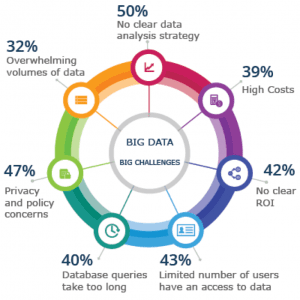
The major challenges small businesses face when it comes to Big Data are outlined in this graphic:
Sources of Big Data
To eliminate the aforementioned barriers and allow you to use Big Data in the most efficient way, you’ll need to understand the major sources of Big Data:
Data from social communication
Despite poor structuring, the volume of data generated here is enormous. This group covers all the social networks, blogs and comments on them, pictures and infographics, videos, user-generated maps, emails, etc.
Data obtained via the Internet of Things
It has become widespread and popular to generate data with the help of special devices and sensors that can measure physical processes in a human body or inanimate objects. The data obtained in this way are well-structured and reliable. Among the devices that are used to acquire such information are wearables, weather sensors, traffic sensors, pollutions sensors, webcams, surveillance videos and images, tracking sensors.
Traditional records
The data stored in such records includes reference charts, commercial transactions, metadata, medical records, banking and stock records. They are actually stored in database systems.
Smarter business decisions
Apart from the complexities it creates, Big Data brings opportunities to make smarter business decisions and thus boost operational efficiency. All in all, it is aimed at helping companies improve product quality, enhancing marketing tactics and prolonging customer relationships. Instead of relying on personal intuition and some general practices, it’s better to use and analyse Big Data in the most efficient way.
As a small business owner, you can analyse modern buying trends and easily customise your selling offers to meet them. In the same way, with new Big Data analysis tools, you could analyse your visitors, track their actions on your website and see what they like/dislike the most.
However, certain misconceptions about the cost may often scare small businesses away from introducing Big Data analytics solutions to their corporate environment. The truth is that those solutions that are built for large enterprises are too costly to adopt. Fortunately, Big Data technology developers constantly work on creating solutions that are more suited to small businesses allowing them to accomplish more in a shorter time. The major characteristics to look for in Big Data technology are flexibility, simplicity and cost. Consider some existing tools useful for small businesses to collect information such as Google Analytics.
Use big data properly
You might collect data from all the possible sources but you will hardly find time to analyse even half of it. You need to understand clearly which data sets are going to be of real use for your business. Depending on your business type, there will be different areas to focus on. Areas small businesses usually aim to enhance include profitability, revenue, CRM, operational efficiency and risk management. Decide for yourself what is your top priority before collecting the necessary data.
When you know which data you are looking for, it’s time to decide how to analyse it and identify how this data is going to solve your problem. Make sure you can trust the sources you use. What is equally important is preventing your data from being stolen or hacked. Depending on your data sensitivity, choose a relevant level of protection. Finally, consider the ways of monetising your data and figure out how it’s going to generate more sales.
The bottom line
All in all, when used and analysed properly, Big Data can solve a number of business challenges that companies face. Experts advise the automation of data collection, generating insights out of acquired information and taking relevant actions that can lead to desired outcomes. However, when dealing with enormous sets of data, you risk getting caught by it unless you have a plan for managing and monetising your data.
About the author
 Beata Green is Director of HeadChannel Ltd, a London-based bespoke software development company. She is responsible for overall strategic direction and overseeing the company’s continuing growth, building closer client relationships and maintaining best working practices. She enjoys brisk country walks with her red fox labrador and then relaxing in front of a TV crime drama with a glass of red wine.