
Losing your voice to throat cancer, Parkinson's disease, or another medical condition doesn't just take away the ability to speak. It takes away a part of how a person is recognised by everyone who knows them. A Brisbane company has spent six years trying to get that back, and it's just raised $5 million to take the technology further.
Laronix has closed an oversubscribed pre-Series A round, backed by Australian deep-tech investor Seefeld Investors and Singapore-based 12 Ventures, alongside individual investors including Dr Elaine Saunders and Dr Peter Blamey of Blamey Saunders Hearing, and Modibodi founder Kristy Chong.
What the company has actually built is the interesting part. Laronix's Voice AI technology recreates a patient's original voice from just ten seconds of recorded speech, preserving their accent, tone and individual vocal characteristics rather than producing the mechanical, often male-sounding speech typical of older artificial larynx devices. Patients don't need to have deliberately recorded their voice before losing it either. Ten seconds pulled from an old family video or voicemail is enough.
That ten-second figure is a long way from where the technology started. Early AI-enabled voice recreation approaches needed hours of recorded speech, a bar Laronix brought down to around 20 minutes through its own research. The bigger leap came in 2025, when Laronix was selected for the Google for Startups Accelerator: AI First program and worked with Google's AI specialists to cut the requirement down to ten seconds.
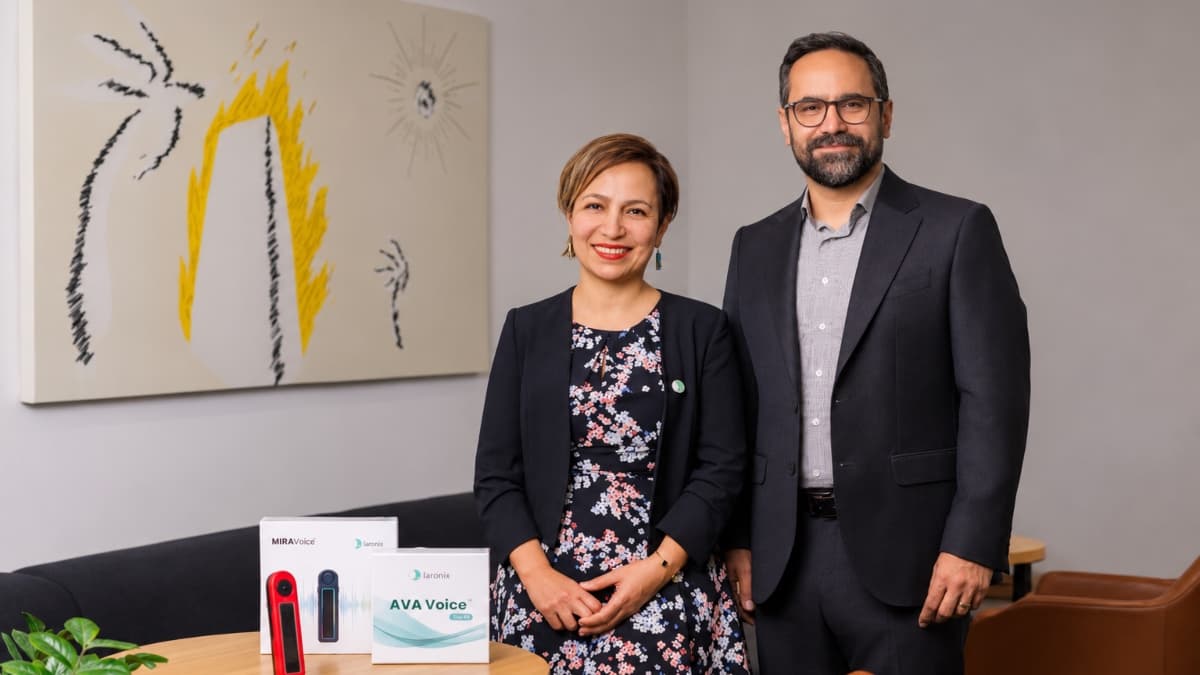
Co-founder and CEO Dr Farzaneh Ahmadi, who founded the company in 2020 with her brother, co-founder and COO Dr Mousa Ahmadi, says the funding will go toward getting the technology to more patients.
"This investment will help Laronix establish its position as a world-leading innovator in voice restoration technologies and bring its products to more voiceloss patients in Australia, the US and Europe."
The company's first commercial product, AVA Voice, is a non-invasive artificial larynx already used by hundreds of patients across hospitals in Australia and the United States. Its Voice AI technology has been piloted with more than 50 patients and clinicians across ten hospitals in both countries, including the University of South Florida. A second product, MIRA Voice, is an FDA-registered voice box due to launch in 2027, built for a broader range of conditions including patients temporarily unable to speak in intensive care.
Dr Mousa Ahmadi frames the work as addressing something that goes beyond communication.
"For decades, the loss of one's voice has meant the loss of a fundamental part of one's identity. Laronix is changing that. Over several years, we have worked closely with patients and key opinion leader clinicians to ensure our technology addresses genuine medical needs across the full spectrum of voice-loss conditions. Our ambition is to make personalised voice restoration accessible to millions of people worldwide, and this investment brings us significantly closer to achieving that goal."
Kristine Song, 2025 Program Lead for the Google for Startups Accelerator in Australia and New Zealand, says the company was a standout in its cohort.
"At the Google for Startups Accelerator Program, we believe the most exciting innovations happen when advanced technology meets deep human empathy. Laronix perfectly embodies this, to give voice-loss patients their natural speech back. We were incredibly proud to support the Laronix team during their time in our 2025 Google for Startups Accelerator program. We look forward to partnering with more local founders who are driving this level of life-changing innovation."
Laronix sits inside a broader pattern in Australian health AI, even if the other players are solving a different problem. Melbourne-based Heidi Health uses AI to transcribe medical consultations and handle clinical documentation, taking paperwork off doctors rather than restoring a patient's voice. It now processes more than two million consultations a week across over 110 countries and has raised more than $100 million to date. Lyrebird Health runs a similar medical scribing tool used across Australian GP clinics, transcribing and formatting consultation notes and generating referrals, and emerged from the Startmate accelerator before an integration with Best Practice Software that extended its reach to a large share of Australian general practices.
None of these companies compete with Laronix directly. What they share is a pattern of Australian AI startups finding genuinely difficult, specific medical problems, a lost voice, a doctor buried in notes, and building narrowly around solving that one thing well. Laronix's next product, MIRA Voice, will test whether that approach holds up as it moves from pilots in ten hospitals toward a commercial launch across three continents in 2027.