
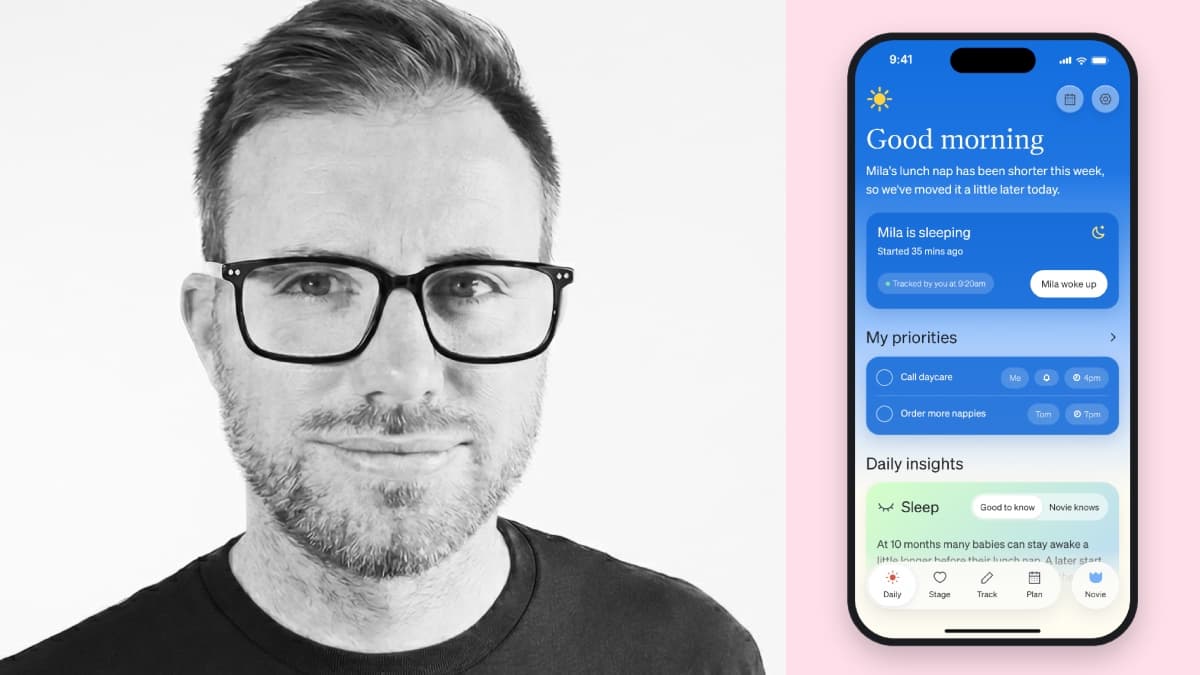
Isabella Young had never written a line of software before she built the first version of her parenting app using Claude. For months, that was enough. Novie, which gives parents expert-curated guidance on sleep, nutrition and child development alongside tools for running a household, took shape entirely through AI coding tools, with no formal development background behind it.
Then she hit problems AI couldn't solve.
That's a familiar point for a lot of founders right now. Startmate Muster's 2025 Comparison Report on AI found software development was among the fastest-growing uses of AI among startups, rising from 34% in 2024 to 52% in 2025. As the technical barrier to building something falls, founders can take an idea further on their own before they need to bring in specialist help. The harder question is what happens once that early build needs to become a product people actually rely on.
For Young, that meant handing the rebuild to Australian AI studio CoAligned, which became Novie's primary development team while she kept ownership of the product vision and focused on growing the business. Novie launched on the App Store in November.
"DIY is good for a demo, but experts know how to turn that demo into something valuable," Young said. "With a consumer app, trust is everything. One bad experience reflects on the brand, so having a team that tests to the nth degree matters. It also frees me to build the rest of the company."
CoAligned is working on a second consumer app at the same time, AiOlé, a cooking app featuring celebrity chef Miguel Maestre that uses real-time conversational AI to help users cook with whatever's in their pantry, work out portions, and follow along with Maestre's expertise. It's due to launch in December.
The studio's pitch is built around a gap Young's experience illustrates directly. Mark Boehm, co-founder and director of CoAligned, says an AI-built prototype is a useful starting point, not a finished product.
"An AI-built prototype is a starting point, not a finished product. There's still engineering work involved in making sure the architecture is sound, the product works reliably, and the experience is right for the people using it. That's the point where specialist product and engineering expertise makes a real difference."
CoAligned's team includes engineers and designers who've come from Canva, Relevance AI and Immutable, and the studio has grown sevenfold over the past year. It recently promoted Inga Pflaumer, formerly Head of Engineering at Relevance AI, to CTO. That kind of senior engineering access is normally out of reach for an early-stage founder, who would otherwise need to raise capital and build a full engineering team before knowing whether the product and the business are even worth it. Boehm says the studio's model is to help founders build first, then decide when the capability makes sense to bring in-house.
"We've built a team that has shipped products used by millions of people, and we're putting that experience to work for founders much earlier than they could normally access it."
The studio has also struck a deal with Luft Ventures, a venture builder and early-stage fund, to act as development studio for companies backed by its first fund, supporting them until they're ready to build their own technical teams.
"AI has made it easier than ever for founders to start building, but the hard part is turning that first build into a product that can scale," said Yen Ngai, co-founder of Luft Ventures. "CoAligned gives our portfolio companies the talent to build complex products quickly, and to build them well."
For a small business owner who's used ChatGPT or Claude to knock together a basic tool, a booking system, an internal tracker, a simple customer-facing app, Young's experience is a useful marker rather than a cautionary tale. AI got her a working demo for months on her own. Getting from there to something strangers could trust with their family's routine took a different kind of help entirely.