
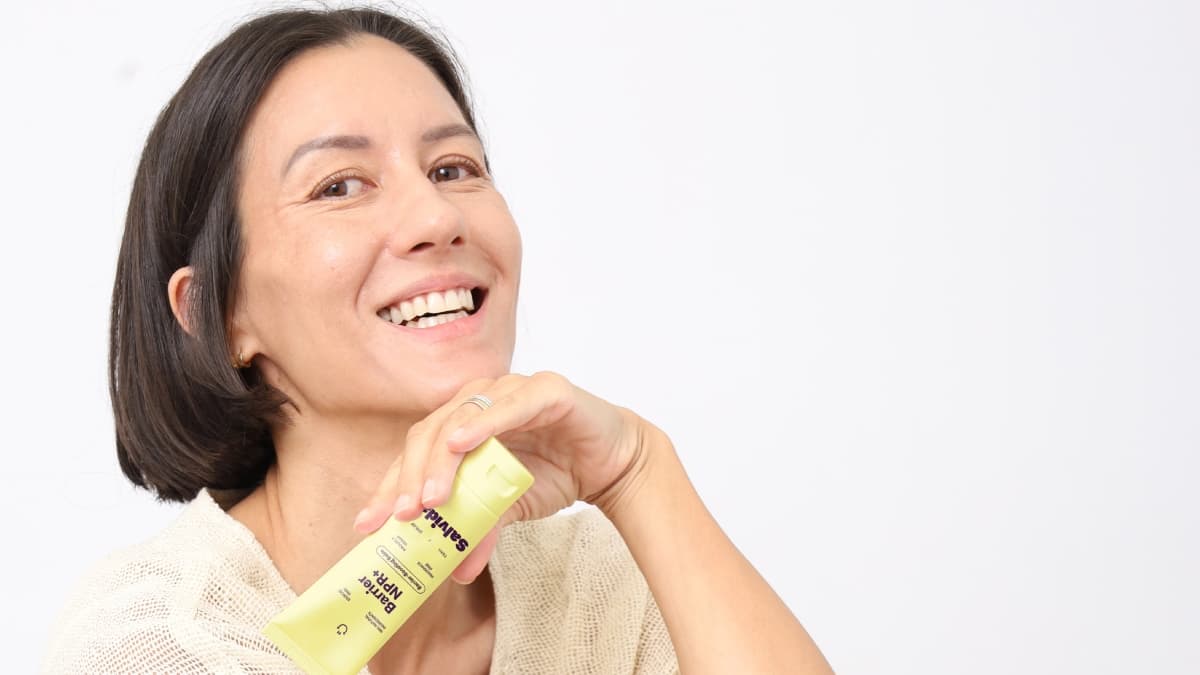
Jacqui Vidal was on a mission to find skincare products that would work for her daughter's severe eczema, but she just couldn't find anything that gave her peace of mind. So, she took matters into her own hands and started creating her own products.
Two years on, that frustration has turned into Salvida, an Australian skincare business on track to hit $1.3 million in forecast revenue. What makes the story unusual isn't just the growth, it's how few people it took to get there. Jacqui runs almost every part of the business herself, supported by two casual pick-and-packers.
For a consumer brand competing in one of the most crowded retail categories going, that's an unusually lean setup. But according to Jacqui, keeping Salvida small was never about avoiding growth. It was about being deliberate over where growth actually required more people, where technology could pick up the slack, and where the customer relationship needed to stay human no matter what.
A problem she knew personally
Salvida didn't start as a business idea looking for a market. Jacqui had dealt with eczema herself for more than two decades, but it wasn't until her eldest child's eczema became unmanageable at age 10 that she found herself back in the same frustrating position she remembered from her own childhood. Nothing on the shelf offered what she needed, so she began formulating barrier-support products at home.
She wanted products, and a brand, that spoke to the exhaustion and emotional toll of chronic problem skin, not just the visible symptoms. That thinking shaped more than just the formulas. It shaped how she built the whole company.
Rather than launching a sprawling product range, Salvida settled on three products designed to work for both children and adults: a gentle daily face and body wash for the whole household, a water-free zinc-and-oatmeal barrier balm for flare-ups, and a richer moisturising lotion for everyday maintenance once skin has settled. The range is Australian-made and owned, dermatologist-tested, steroid-free, fragrance-free and naturally derived, and carries the Eczema Association of Australasia Seal.
Why she didn't hire
The most striking part of Salvida's operating model is simply its size. Most growing consumer brands add headcount as revenue climbs. Jacqui has largely resisted that instinct. Functions that would typically be split across several employees, marketing, customer relationships, operations, product development and business decisions, all still sit with her.
The upside is control. Fewer layers between Jacqui and the decisions shaping the company, and none of the fixed staffing costs that usually come with scaling a consumer brand. For a bootstrapped business, that matters. Revenue growth doesn't have to mean overheads growing at the same pace.
Instead of adding people, Jacqui has leaned on technology and systems to absorb extra workload. AI has become one of the tools she uses to help Salvida operate at a scale that would otherwise be difficult to manage solo. Her logic is straightforward: if a piece of technology can make a repetitive or time-consuming task faster, it frees up capacity without needing to add another employee. For Jacqui, that makes AI less about replacing people and more about creating leverage, letting her maintain a lean structure while still handling the growing list of tasks that come with running a business forecast to hit $1.3 million.
The one thing she won't automate
There's a clear limit to how far that philosophy goes. Customer service is the one area Jacqui refuses to hand over to automation.
Salvida's customers are often parents trying to work out what's appropriate for children dealing with eczema, atopic dermatitis or sensitive, reactive skin. Those conversations carry real concern and highly personal experience, which is exactly why Jacqui treats customer service as fundamentally different from an administrative task. Every email and customer message goes straight to her inbox, keeping the one-to-one relationship intact.
It's a deliberate choice at a time when plenty of businesses are leaning further into chatbots and automated responses to cut down on human interaction. Jacqui's view is that technology can provide the backbone of a lean business, but it can't replicate the trust built when a real person takes the time to actually answer a customer's question. That distinction has become part of Salvida's competitive edge, because the company isn't just selling another moisturiser. It's talking to people who may have already spent years trying products that didn't work.
Proving it, not promising it
That same instinct, credibility over claims, shows up in how Salvida approaches its product testing. Rather than asking customers to take its marketing at face value, the brand invested in independent clinical and consumer testing. The range underwent independent laboratory testing and was included in a four-week trial involving 172 households, recruited specifically from people living with eczema, atopic dermatitis or sensitive, reactive skin.
After four weeks, 88% of participants said their skin looked or felt noticeably better, and 89% said they'd recommend Salvida to family and friends. For Jacqui, that testing reflects the same principle running through the whole business: prove the value, rather than simply promise it. It also gives a small, Australian-owned brand a way to build credibility without trying to outspend far larger competitors on marketing.
Starting narrow, and staying narrow
There's a broader lesson in Salvida's growth beyond the technology and the team size. The business started with a problem Jacqui had lived through herself, then watched her daughter live through too. That gave her an unusually specific understanding of her customer from day one, rather than a broad ambition to "launch a skincare company" and figure out the audience later.
That focus has stayed central. The three-product range is deliberately narrow rather than an attempt to cover every possible skin concern, and the brand is built around one clearly defined customer group, people dealing with eczema, atopic dermatitis and sensitive or reactive skin. For a small company with limited resources, that kind of focus makes it far easier to decide where those resources actually go.
A different way to think about scaling
Salvida's story isn't an argument that every business should stay small forever. It's a demonstration of what happens when a founder is genuinely selective about where extra resources create real value. Jacqui could have used growth as the reason to expand her team quickly. Instead, she's used technology to increase her own capacity, kept fulfilment support focused on the physical work that genuinely needs extra hands, and held onto personal involvement in the one part of the business where she believes human interaction matters most.
That's a different model of scaling to the usual assumption that revenue growth requires headcount growth at the same pace. It keeps the business flexible, and keeps more of the revenue generated by growth available for the parts of the brand that matter most.
The way Jacqui has structured Salvida mirrors the reason she started it in the first place. She built the company because she believed people with problem skin deserved something better than another product making another promise. She's applied that same mindset to how the business runs: keep the range focused, keep the team small, use technology where it creates leverage, stay close to the customer, and when trust is on the line, keep a real person involved.
Salvida's forecast $1.3 million second year suggests that, so far, the model is working.