
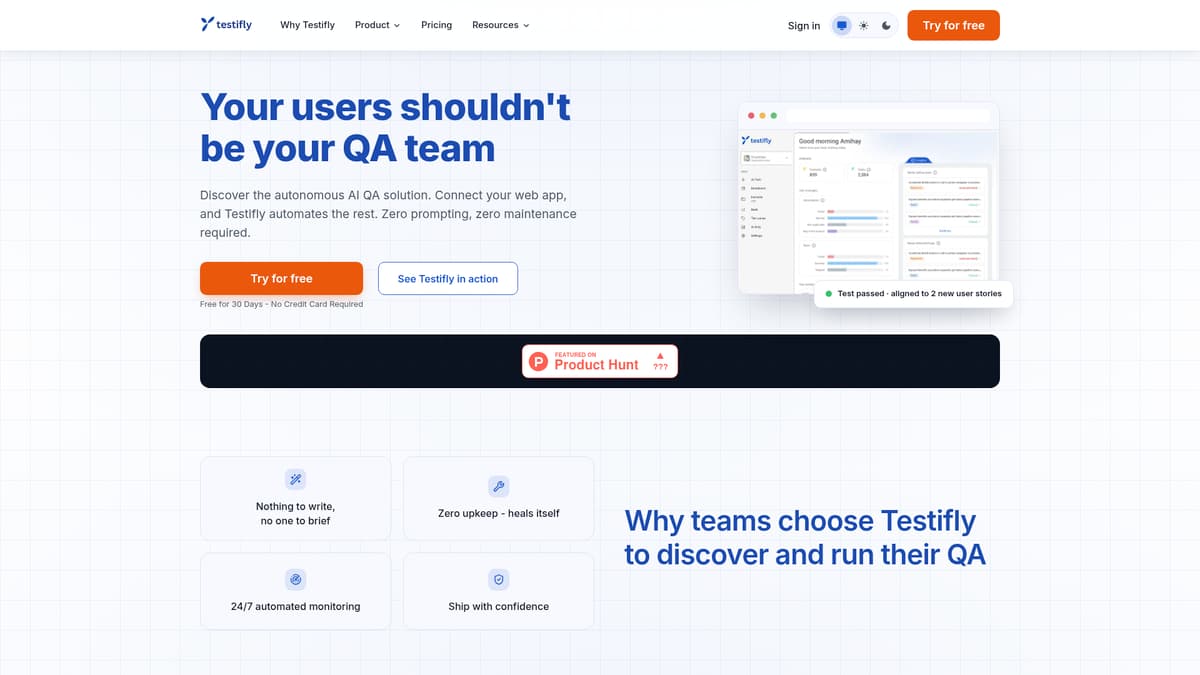
Testifly is an autonomous AI-powered quality assurance tool built for web applications. Rather than relying on teams to write and maintain test scripts, Testifly automatically discovers real user flows by crawling your site, generates tests without manual authoring, runs them continuously on deployment, on a schedule, and across environments, and maintains them through UI changes via self-healing and root cause analysis. It aims to deliver broad test coverage, fast feedback, and reduced maintenance overhead for teams that may lack a dedicated QA engineer.
Key Features
AI Flow Discovery and Zero-Authoring Test Generation: After providing your app’s URL and login credentials if required, Testifly autonomously maps your web application’s features, such as pages or UI areas, and generates tests in four categories: Visibility, Functionality, Business Logic, and Negative testing. You do not write test cases, selectors, or briefings manually.
Continuous Monitoring, Regression Detection, and Self-Healing: Tests run on every deployment, on a schedule, and across environments. When a feature’s behavior changes or UI elements are altered, Testifly adapts existing tests automatically through self-healing or flags regressions, distinguishing between genuine bugs and UI drift. Each failure includes a video recording and root-cause analysis.
Integration and Workflow Support: Testifly integrates with tools like Jira, Linear, Notion, and Slack for issue management and alerts. Every plan includes an API for integrating into CI/CD pipelines. For apps behind VPNs, there is a Remote Runner option.
Feature Management and Customization: Users can manually add features or import them via issue trackers. Features include definitions, overview, UI components, and tests. Tests are grouped into suites, such as Sanity, Smoke, and Regression, and runs are scheduled or triggered.
Security and Hosting Flexibility: Test passwords are encrypted. There is both cloud execution and on-prem or firewall-protected environments via Remote Runners. Users get access controls and environment separation for staging, production, and other environments.
Pricing
Starter: $29/month gives access to one project, with 50 automated tests, 5,000 test executions per month, unlimited users, and email support.
Growth: $89/month for one project with 225 tests, 50,000 executions per month, plus Blast Radius for change impact visibility, integrations, and priority support.
Business: $249/month for two projects, with 750 tests, 200,000 executions per month, and priority support.
Enterprise: Custom pricing offering on-prem execution, custom test and execution limits, dedicated support, and contract terms.
Every plan begins with a 30-day Discovery free trial, with no credit card needed, during which Testifly maps the app and lets you run tests on up to three live features. After trial expiry, the project becomes read-only until a paid plan is activated.
Who Is It For?
Testifly is most suited for small to medium-sized teams, such as startups, agencies, and product teams, particularly ones that:
Ship frequently but do not have the capacity to maintain large QA teams.
Want strong end-to-end coverage without investing in writing and updating tests manually.
Need to catch regressions early, across multiple environments or products.
Use or want integrations with tools like Jira, Linear, Notion, Slack, or CI/CD pipelines.
Specific roles that can benefit include Product Managers, Engineering Leads, DevOps teams, small businesses, and teams with one to five developers. Larger enterprises may find value under the Enterprise plan, especially when governance, on-prem hosting, or custom terms are required.
Final Thoughts
Testifly delivers a compelling option for businesses seeking to automate web app QA without the usual overhead of script maintenance. Its autonomous flow discovery, self-healing tests, and integration suite help reduce manual work, making it especially fit for teams that move quickly and need reliable safety nets. However, teams that require full control over test code, custom scripting, or very granular test behavior may still prefer tools like Playwright or Cypress. For many businesses, Testifly offers a balance of sufficient test coverage, reduced maintenance, and visibility into errors at a manageable cost.
Visit the official website for more.
Keep up to date with our stories on LinkedIn, Twitter, Facebook and Instagram.