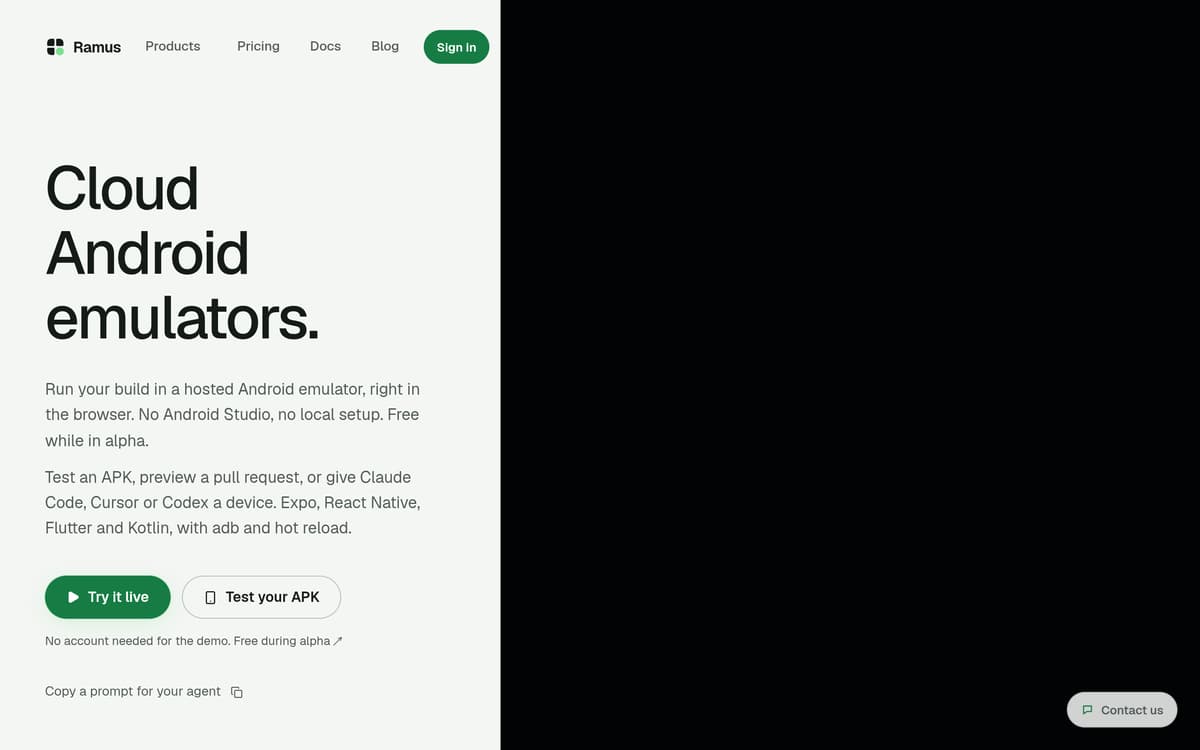
Ramus is a cloud-based service offering hosted Android device emulation for building, testing, reviewing, and previewing Android applications without requiring local setup. Ramus enables developers to upload APKs or connect GitHub repositories so that pull request previews run inside emulators accessed via browser or terminal tools. It also allows AI agents like Claude Code, Cursor, or Codex to use these virtual devices as part of automated testing flows or app review processes. Its goal is to streamline mobile development, reduce device setup overhead, and improve workflow visibility.
Key Features
Cloud Android emulators hosted on Ramus's fleet, accessible via browser or command-line tools, eliminating the need for local Android Studio or SDK setup. Supports native Android, Jetpack Compose, Expo, React Native, and Flutter apps. Debug and release APK builds are both accepted.
Pull request preview integration: developers can connect their GitHub repos so that Ramus builds branches in isolated environments and attaches a live preview link to each PR, which lets reviewers interact with the app changes directly in a browser.
Agent tooling: allows AI agents such as Claude Code or Codex to pick up devices, monitor app behavior, take screenshots or automated snapshots, and even hand off control via shared device links. The ramus-cli tool supports session management, APK uploads, taps, text input, screenshots, and logcat.
Clean environment and security: each session starts in an isolated, clean virtual machine; device state is discarded at session end. Builds use short-lived GitHub tokens scoped to selected repos. Secrets or credentials are not required for builds unless part of repository-protected workflows. Privacy practice involves storing only limited metadata; video or device session contents are not persistently recorded.
Pricing
Ramus is currently in alpha and free to use. All core offerings, including APK uploads, PR previews, and agent integrations, are offered without charge during this alpha period.
Try-without-account ("CLI trial"): gives up to 60 minutes of CLI access, one active Android session, support for APKs up to 150 MB, CLI tools, screenshots, and a browser watch link. Up to three such trials per IP per day.
Signed-in accounts can access slightly elevated capacity: up to two concurrent sessions, APK size up to 300 MB, browser upload, CLI, agent tools, GitHub pull request previews, and local development workflows.
Who is it for?
Mobile app development teams or solo developers focused on Android who want to accelerate testing without maintaining local devices or emulators.
Organizations that conduct code reviews, QA, or integration testing and would benefit from including previewable, interactive versions of apps in pull requests.
Teams using AI-assisted development tools or agents that can automate testing or workflows; Ramus makes it possible to pair agents with physical device emulation to validate UI or behavior.
Businesses that work with multiple Android app platforms and frameworks (native, Flutter, React Native, etc.) and require cross-framework support and consistency with limited infrastructure management overhead.
It is less suitable for those targeting iOS or platforms other than Android at present, as Ramus supports Android emulators only. Also, teams requiring long-running sessions or large device fleets may need external capacity or await future expansions.
Final Thoughts
Ramus offers a compelling solution for Android-centric development workflows by removing setup friction and centralizing builds, previews, and agent-driven testing in the cloud. The free alpha stage provides meaningful functionality for many developers, especially those working with pull requests and automated review pipelines. It shines for teams seeking speed, collaboration, and better alignment between code changes and app previewing. As the platform matures—especially if capacity, supported platforms, or pricing tiers scale—Ramus could become an integral tool in Android development toolchains.
Visit the official website for more.
Keep up to date with our stories on LinkedIn, Twitter, Facebook and Instagram.