
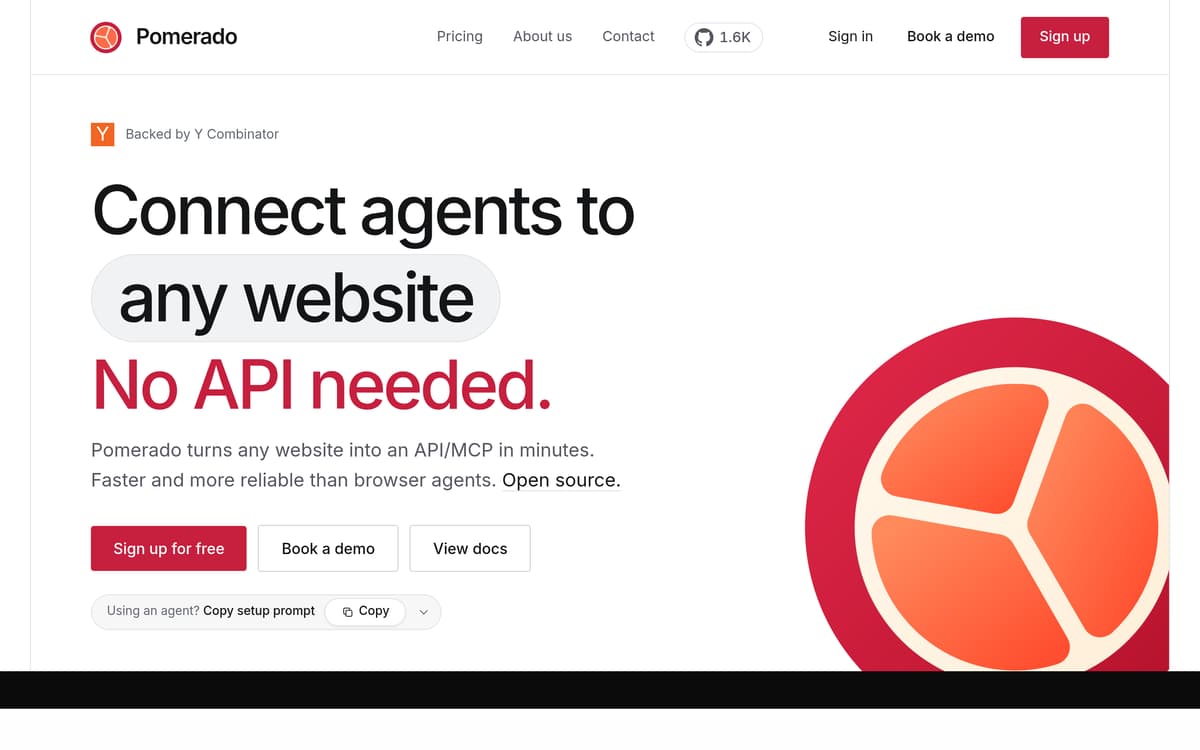
Pomerado is a cloud platform that enables business AI agents to interact with websites that lack public APIs, such as legacy portals, vendor dashboards, ERPs, and internal tools. By converting these sites into callable APIs or agent-centric MCP tools, Pomerado helps organizations automate workflows that otherwise require repeated manual navigation or browser scripting. Integrations authenticate into sites, including ones with two-factor authentication, execute tasks, detect when sites change, repair themselves, and return structured results, freeing teams from brittle browser-based automation.
Key Features
Website-to-API / MCP Conversion: Users describe the task they want accomplished, such as listing invoices by status on a supplier portal, and Pomerado generates a reusable integration that functions like an API or MCP tool for that site. This works even when the site has no existing API.
Managed Authentication: Pomerado handles sign-ins, including two-factor code flows such as SMS, email, or authenticator apps. Users can choose to pass credentials with each request or save them securely. Credential storage is optional and handled with privacy in mind.
Self-healing Integrations: If a website layout or functionality changes and an integration fails, Pomerado detects the failure, updates the tool, tests it, and finishes the original request without requiring manual fixes.
Hosted Infrastructure & Access Controls: All integrations are hosted, scaled, and access-controlled by Pomerado. There is no need for customers to provision servers. Role-based permissions, audit logs, and other enterprise controls are available on higher tiers.
Performance and Cost Benchmarks: According to its own tests, Pomerado delivers approximately 2x faster execution, costs 10 to 1,000 times less, and is about 30% more accurate than browser-based agent systems like Astra Computer Use, Instinct, or Muse. In one onboarding example, Pomerado completed a multi-app HR, IT, course, and library setup in about 8 minutes for a few cents, while a browser agent took over 21 minutes and substantially more cost.
Open Source Core: Pomerado’s integration minting framework is released under an MIT license. Users can deploy locally and see the underlying integration code. There is also a fully managed cloud service offering all the above features.
Pricing
Pomerado offers three main tiers of service:
Free: $0 per month. Includes up to 100 tool calls per day, 10 new integrations per month, and one connected account per website.
Premium: $50 per month. Provides up to 1,000 tool calls per day, 100 new integrations per month, and still one connected account per website. Annual billing options are available.
Business (Enterprise): Pricing on request. Designed for heavy usage, with 100,000+ tool calls per day and 1,000+ integrations per month. This plan adds features such as unlimited accounts per website, private integrations, roles and permission management, audit logs, SLAs, custom 2FA and proxying, MCP code ownership, and 24/7 support.
Limits on tool calls, number of integrations, and number of connected accounts per website are enforced based on the chosen tier. Pricing details and terms are up to date as of late October 2026.
Who is it for?
Pomerado is best suited for organizations and roles where website automation is essential but API access is unavailable or impractical. Typical users include:
Operations, finance, and procurement teams that need to pull data from supplier portals, invoice dashboards, or billing systems without APIs.
IT or DevOps teams automating internal workflows where legacy applications or custom vendor tools obstruct agent tasks.
Robotic process automation specialists and AI developers who build agent-based automations and prefer reliable, repeatable integrations rather than browser-based scripts.
Businesses in regulated industries such as finance, healthcare, and government that require audit logs, role-based permissions, and compliance support and wish to embed login handling and credential security into their automations.
It may be less fitting for those seeking out-of-the-box tools built for specific functions, such as recruiting or marketing automation, or for use cases that involve sites whose terms of use explicitly disallow automated access. Early users mentioned include car dealerships and personal service businesses automating administrative tasks.
Final Thoughts
Pomerado addresses a common bottleneck in AI-driven automation: the lack of stable, maintained APIs for many essential systems. Its approach combines on-demand integration builds with persistent, self-maintaining tools that handle authentication and adapt to site changes. For businesses frustrated by brittle browser-based agents or repetitive manual workflows in portals, it offers a way to modernize without waiting for third-party APIs. That said, its claims of cost and speed gains come from internal benchmarks, so prospective users should validate performance in their own environments. In summary, Pomerado represents a compelling option for organizations that want to unlock automation across fragmented web interfaces with minimal infrastructure overhead.
Visit the official website for more.
Keep up to date with our stories on LinkedIn, Twitter, Facebook and Instagram.