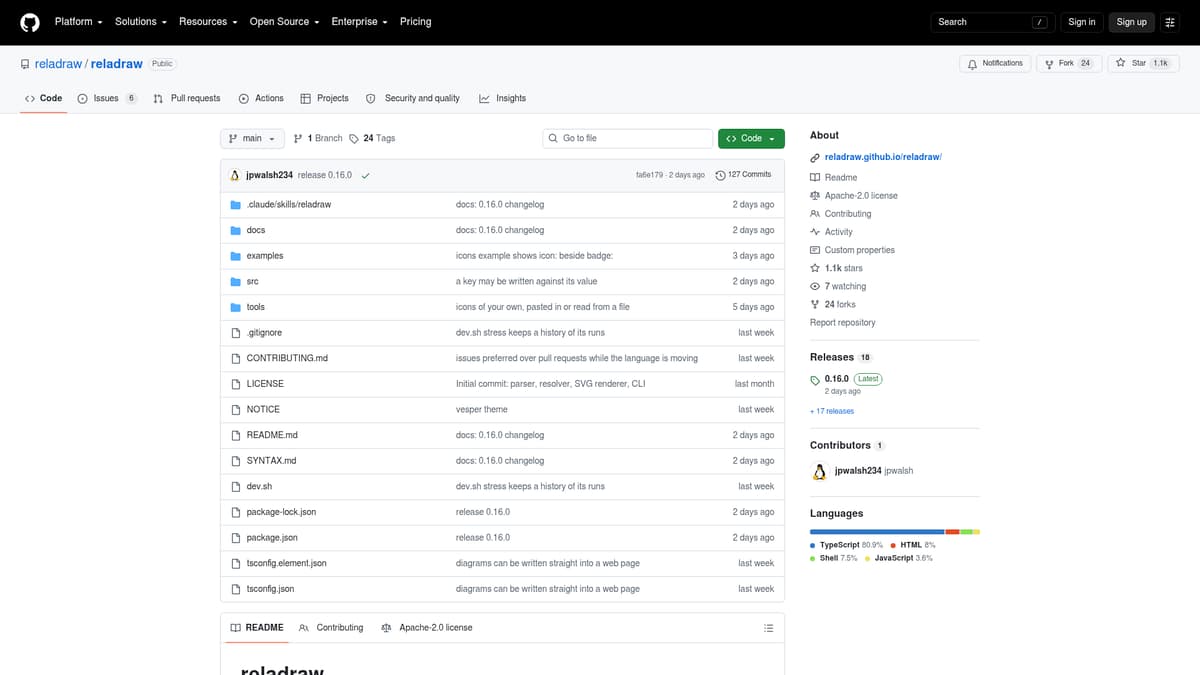
Reladraw is an open source diagramming tool that resolves a common tension in diagram-as-code workflows: you specify diagram structure and relative placement using simple text, and the engine determines exact layout without requiring pixel-by-pixel positioning. For business users—software architects, system engineers, technical product teams—Reladraw solves the problem of maintaining control over the visual structure of diagrams while keeping them versionable, reproducible, and easily modifiable through code or by AI agents.
Key Features
Reladraw enables creation of diagrams using a declarative, textual syntax that specifies elements (nodes, edges, containers) and relative spatial relationships (such as “below”, “right of”, “level with”) rather than fixed coordinates. The layout engine computes positions deterministically, minimizing overlap while honoring constraints.
Rendering is supported via a command-line interface (CLI) that transforms .reladraw source files into standalone SVG images. There are zero runtime dependencies—parser, layout engine, and renderer are implemented in TypeScript for simplicity and portability.
Reladraw provides a playground in the browser to preview diagrams as users write text. It also includes a “skill” module usable with AI coding assistants (e.g. Claude Code, Codex, Cursor, Copilot) so agents can generate, modify, or review diagrams using its syntax.
The project is versioned under the Apache-2.0 license, making it freely usable, modifiable, and deployable in commercial or internal settings. The codebase and syntax are labeled “unstable” in parts, with ongoing work to improve diagnostics (for overlapping nodes, crossed edges, text clipping) and edge routing.
Pricing
Reladraw is completely free to use. There are no paid tiers or subscription plans publicly listed. The tool is open source under the Apache-2.0 license, which allows commercial use, modification, and redistribution without royalty fees. Enterprise offerings, hosted editions, or paid support are not advertised on the official site or repository.
Who is it for?
Reladraw is best suited for businesses and roles that work with system diagrams, infrastructure architecture, data flows, or organizational charts—especially where consistency, version control, and clear visual hierarchy matter. Engineering teams documenting microservices, network zones, or cloud infrastructure benefit from its ability to preserve spatial relationships over time.
Teams that rely on code review workflows or have diagrams stored in Git repositories will appreciate how text-based definitions make diffs small and meaningful rather than forcing updates to layout metadata. Similarly, businesses using AI agents to generate or maintain documentation can integrate Reladraw’s “skill” to allow agents to operate on diagrams via text.
Smaller organizations or single users who need polished GUI tools with drag-and-drop design, real-time collaboration, or very elaborate aesthetic control may find Reladraw’s current capabilities less streamlined, owing to its early stage of development.
Final thoughts
Reladraw fills an important gap between auto-layout diagram tools and drag-and-drop editors, offering a hybrid model that gives business users and technical teams more control without sacrificing maintainability. While still in early versions and with limitations around syntax stability, edge routing, and diagnostics, the open source, no-cost Apache-2.0 foundation makes it low risk to test or adopt. For businesses seeking reproducible, versionable diagrams that can evolve reliably—especially in tech environments—Reladraw is worth a look.
Visit the official website for more.
Keep up to date with our stories on LinkedIn, Twitter, Facebook and Instagram.