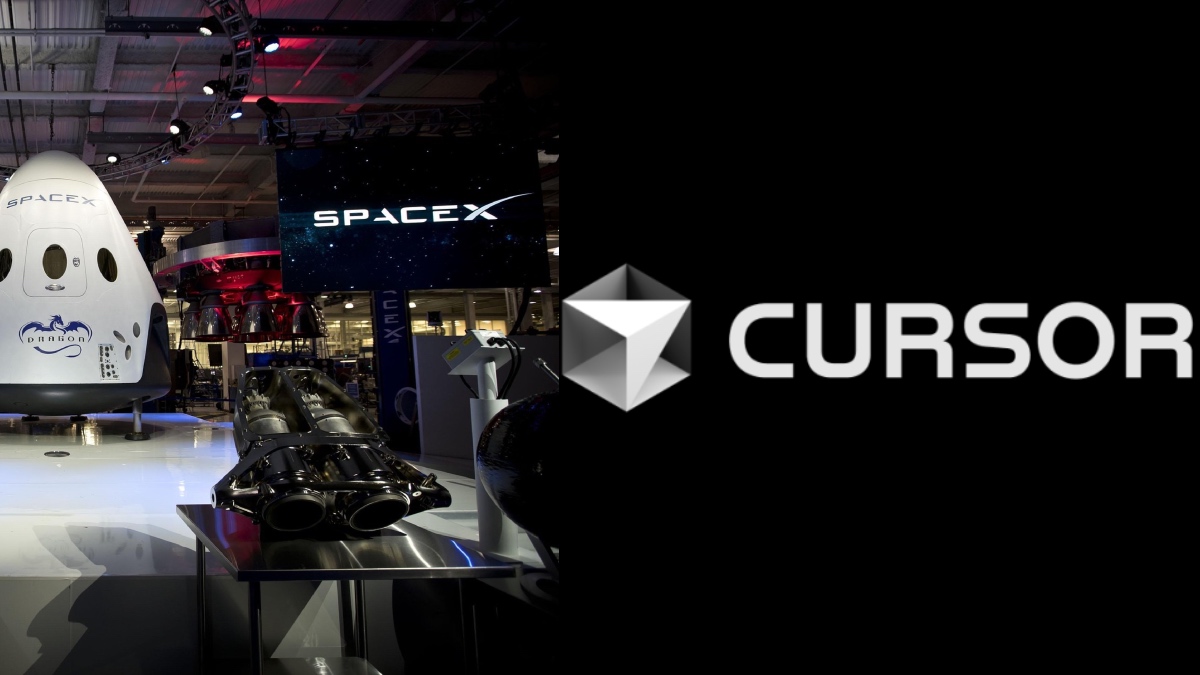
What’s happening: SpaceX has entered a pending merger agreement to acquire Anysphere, the parent company of AI coding tool Cursor, in an all-stock deal valuing Cursor at $60 billion. On the same day, Elon Musk posted that AI will achieve Stockfish-level coding through the combination of Cursor and SpaceX’s infrastructure.
Why this matters: Cursor is one of the most widely used AI coding tools among developers at small tech businesses, agencies, and startups. The acquisition raises immediate practical questions for those users about data, governance, pricing, and whether to stay or switch.
When Elon Musk posted on 16 June 2026 that AI will achieve Stockfish-level coding through SpaceX’s acquisition of Cursor, most people focused on the $60 billion price tag. The more consequential part of that statement is the Stockfish reference.
Stockfish is a chess engine. It does not play chess like a very good human. It plays chess at a level no human can match, calculating millions of positions per second, finding moves that grandmasters cannot see, and winning against the best players in the world essentially every time it tries. When Musk says AI will achieve Stockfish-level coding, he is not describing AI that helps developers write better code. He is describing AI that codes at a level developers cannot match.
That claim is ambitious and unproven. But it reframes what the SpaceX and Cursor deal is actually about, and it raises questions that go well beyond which coding tool your development team uses.
What Musk actually said
Musk’s post on 16 June, tied directly to the SpaceX announcement, read: “AI will achieve Stockfish-level coding and generalised computer use.” The deal he was referring to was the pending merger agreement between SpaceX, through a wholly owned subsidiary called X67 Inc., and Anysphere, Cursor’s parent company. According to the Form 8-K filed with regulators, if the deal closes, Cursor will survive as a wholly owned SpaceX subsidiary. Cursor shareholders receive SpaceX Class A common stock. The implied equity value is $60 billion. SpaceX expects the transaction to close in Q3 2026, pending regulatory clearance.
SpaceX framed the strategic logic in a social media post at the time of the announcement. “The combination of Cursor’s leading product and distribution to expert software engineers with SpaceX’s million H100 equivalent Colossus training supercomputer will allow us to build the world’s most useful models,” the company said. Colossus is xAI’s supercomputer cluster in Memphis, which SpaceX has described as the largest in the world.
What Grok can and cannot do
The obvious question for anyone following this deal is why SpaceX needed to pay $60 billion for Cursor when it already owns xAI and its Grok models, which can already handle coding tasks.
The honest answer is that Grok and Cursor are not the same thing doing the same job. Grok is a strong low-cost coding assistant for codebase reading, debugging, test generation, API automation, and high-volume iteration. It is not automatically the best coding assistant for every developer workflow, especially when the task requires mature IDE integration, long autonomous execution, or high-confidence production refactors. Cursor sits inside the editor, reads the full codebase, understands the project’s context, and operates within the developer’s existing workflow rather than requiring them to copy and paste code into a separate chat window. That embedded, contextual experience is what has made Cursor sticky with developers and what drove it to over $2 billion in annual revenue within four years, doubling in just three months, according to reporting at the time of the initial partnership announcement.
As of late April 2026, xAI does not have a dedicated coding product equivalent to Claude Code or GitHub Copilot. Grok Build, its planned vibe coding and agent tool, had not been publicly released despite being teased since January 2026. That gap is the clearest explanation for why SpaceX moved from a $10 billion partnership option to a $60 billion acquisition. Building the distribution Cursor already has would have taken years. Buying it took a filing.
Why Cursor is worth $60 billion
Developers spend their entire working day inside a code editor. A tool that lives inside that editor, rather than alongside it, has a fundamentally different relationship with the user than a chatbot or a separate AI interface. It sees everything, understands the project’s history, and can act on that understanding in real time.
That depth of integration is what makes Cursor hard to replace once a development team has built their workflow around it. It is also what makes it strategically valuable to a company trying to build vertically integrated AI infrastructure. If SpaceX controls the compute layer through Colossus, the model layer through xAI and Grok, and the developer tool layer through Cursor, it has a position across the entire AI-assisted software development stack.
The developer community’s reaction to the deal has been immediate and pointed, and the concerns being raised go beyond price and product. The first and loudest question is about data. Cursor sits closer to proprietary source code than almost any other developer tool. When a developer uses Cursor, they are giving it access to architecture decisions, product roadmaps, unreleased features, and code that may represent years of company investment. Under previous ownership, that access was governed by Anysphere’s data policies. Under SpaceX, the question of what governance and safeguards will exist is being asked directly, and so far has not been answered.
The second question is about training data. Multiple developers in online communities have raised the concern that Cursor’s codebase access will be used to train Grok, drawing comparisons to how X’s data has been used to train xAI’s models. That concern is not unfounded. Vertical integration of data across platforms is a documented pattern in how Musk’s companies operate, and there is currently no public commitment from SpaceX that Cursor users’ code will not be used for model training.
Finally the deal is an all-stock transaction. Cursor shareholders receive SpaceX Class A common stock. One developer with direct knowledge of the space noted that the stock supporting the deal is highly speculative, possibly among the most speculative ever seen, and raised the question of what happens to Cursor’s development and support if that stock underperforms before or after the transaction closes.
What this means for your team
For small businesses and development teams currently using Cursor, the immediate practical questions are about continuity, pricing, and data. The deal has not closed. SpaceX has not announced changes to Cursor’s product, pricing, or data policies. Until it does, the tool works as it always has. If your development team uses Cursor to work on proprietary code, unreleased products, or client work, it is worth reviewing your current Cursor subscription terms and understanding exactly what they say about data use and model training. If those terms are unclear or insufficient for your risk tolerance, that is a conversation to have with your team before the deal closes, not after.
The longer-term question is if AI coding tools become genuinely superhuman, not just faster or cheaper than developers but categorically better at the task, the economics of software development inside small businesses change significantly. That does not mean developers disappear. It means the nature of their work shifts from writing code to directing, reviewing, and validating code that AI produces.
Keep up to date with our stories on LinkedIn, Twitter, Facebook and Instagram.