
Business confidence continues to be hurt by high inflation, skills shortages, and rising costs.
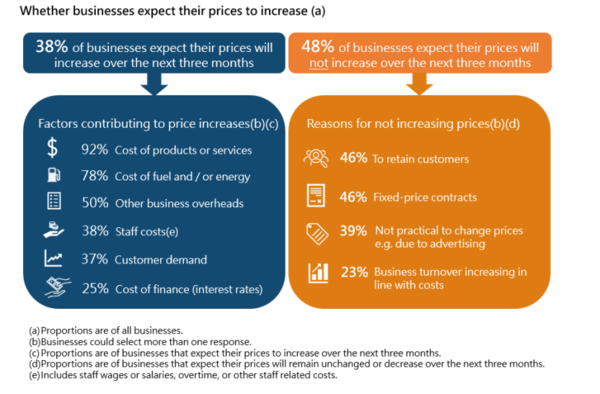
Over a third of all businesses (38%) anticipate raising the price of their goods or services by more than usual in the next three months, a similar result to March 2022, according to the Australian Bureau of Statistics (ABS).
ABS Head of Industry Statistics, John Shepherd, said: “Most of these businesses were finding that increases in the cost of products and services (92 per cent) and fuel and energy costs (78 per cent) were leading factors for planned price increases.”
The other side
The survey results also showed nearly half (48 per cent) of all businesses have no plans to increase their prices over the next three months.
“Of these businesses, nearly half (46 per cent) said it was to retain customers and 46 per cent said they had fixed-price contracts in place.” Mr Shepherd said.
The results also provided information about planned capital expenditure over the next three months. Almost one in five businesses (18 per cent) have planned capital expenditure in May 2022, consistent with findings in May 2021 (17 per cent).
Nearly half (48 per cent) of businesses planning capital expenditure indicated it would be higher than what is usual for this time of year, fewer than a year ago when 59 per cent planned for higher expenditure.
The biggest Influencing factors on whether businesses were planning for capital expenditure were uncertainty about the future state of the economy (25 per cent) and supply chain disruptions (23 per cent).
Current inflation in Australia, as in much of the rest of the world, is the result of a combination of short-term and long-term factors and concerns about demand and supply.
The Reserve Bank of Australia previously raised the official cash rate for the first time in over 11 years from 0.1 per cent, which it had been at since November 2020, during the height of the Covid pandemic.
It was raised to 0.35 per cent, which was higher than expected, and the RBA stated that additional increases were on the way.
Also read: RBA tipped to raise interest rates today
Furthermore, the Russian war on Ukraine increased commodity prices significantly above pre-COVID levels. They produce more than one-tenth of the world’s oil and wheat.
Source: Business Conditions and Sentiments, May 2022
Keep up to date with our stories on LinkedIn, Twitter, Facebook and Instagram.