
New research shows 59% of Australian businesses would fail within three weeks of a supply chain shock. Here’s what that means for SMEs and where to start.
How long would your business actually last if your top three suppliers went down? For most Australian businesses, the honest answer is not long.
Just over half, 51 per cent, of global CEOs surveyed say their businesses are unable to maintain day-to-day operations for over three weeks should a major supply chain shock occur tomorrow. Australia, however, faces the greatest vulnerability with only five per cent of Australian firms able to sustain operations for 4-6 months during disruption, the lowest among all markets surveyed.
This compares to 23 per cent of Singapore firms, 18 per cent of US firms, 10 per cent of German firms, and 8 per cent of UK firms.
More concerning, 21 per cent of Australian businesses can only survive disruption for 1-2 weeks, and 59 per cent would fail within three weeks.
The findings come from Proxima’s, a Bain and Company procurement and supply chain consultancy, 2026 Global Supply Chain Resilience Outlook, based on a survey of 515 CEOs from businesses generating over $500 million in revenue across the UK, USA, Australia, Singapore and Germany.
The data
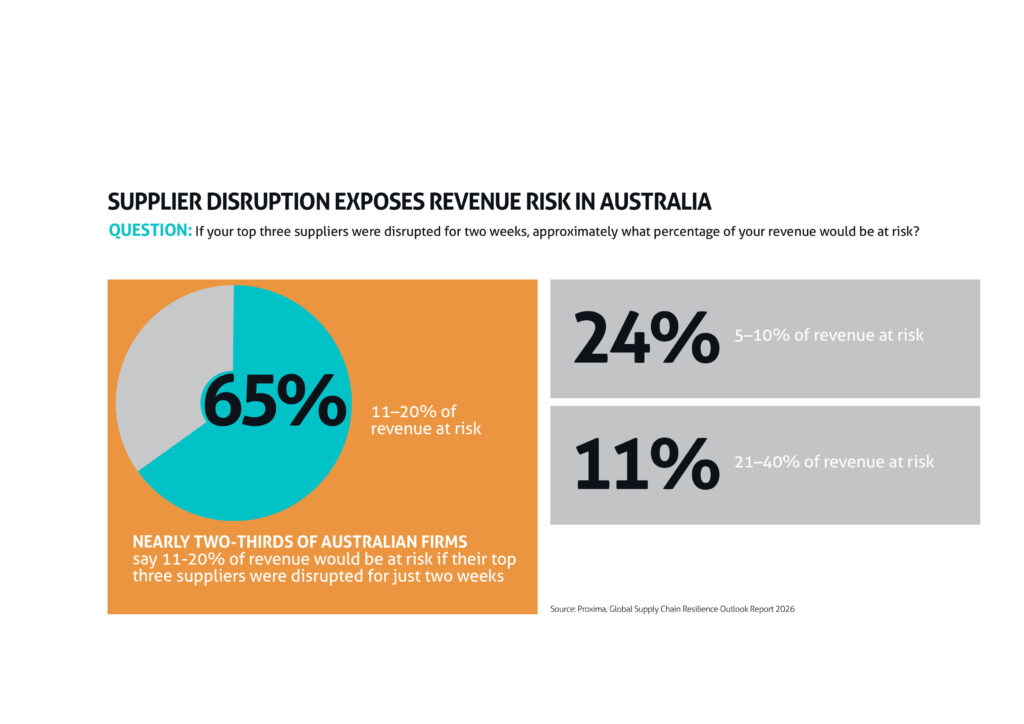
The majority, 65 per cent, of Australian firms shared that a two-week disruption to their top three suppliers would put 11-20 per cent of their revenue at risk.
Australian businesses rank sustainability targets and regulatory requirements, 29 per cent, as their greatest supply chain financial challenge, followed by emerging technologies, 22 per cent, and climate and extreme weather, 16 per cent.
Thirty-eight per cent of Australian businesses experienced supply chain disruption caused by a cyber incident in the past 24 months, yet only 29 per cent have real-time visibility into the cyber risk of their critical suppliers.
Eighty-four per cent of Australian CEOs say procurement is a blocker to AI adoption, higher than the global average of 78 per cent. Yet AI is delivering measurable value in supplier risk monitoring, 53 per cent, and cost modelling, 50 per cent. Barriers to scaling AI adoption include data quality, 43 per cent, skills gaps, 36 per cent, and ROI clarity, 27 per cent.
Why Australia is different
Australia’s geographic isolation, extended lead times, and reliance on long-haul supply routes create structural fragility. Yet this vulnerability is also driving strategic opportunity with businesses actively reconsidering supply chain concentration, increasing demand for local and regional sourcing, and building resilience into core operations.
Lara Mujico, Senior Vice President at Proxima Australia, explains the dynamic plainly.
“Australian businesses face a unique vulnerability due to geographic isolation and extended lead times,” Mujico said.
“A supply chain shock that other markets might weather for longer creates a crisis for Australian operations within weeks. But we’re seeing something positive in that businesses are responding with strategic discipline. They’re investing in resilience, building local relationships, and reconsidering concentration risk.
“The challenge is execution speed. Procurement teams are being asked to deliver resilience faster, but internal processes and capability gaps are creating friction. The businesses winning this cycle are those embedding procurement into strategy early, not treating it as a cost-control function.”
What smarter businesses do
Despite facing the tightest timelines for supply chain recovery, Australian CEOs are taking a disciplined approach to resilience investment. Rather than passing costs to customers, 47 per cent of Australian businesses would fund supply chain resilience through cost-saving measures, the highest proportion among all countries surveyed. Only 34 per cent would pass costs to consumers, and just under one in five, 19 per cent, would accept reduced margin.
To guarantee supply chain resilience, almost three quarters, 72 per cent, of global CEOs would accept an uplift of more than 10 per cent on their current third-party supplier costs. Australian CEOs are similarly committed, recognising that supply chain continuity is fundamental to business viability.
Another positive finding was that uncertainty around global supply chains is driving increased demand for local and regional sourcing in Australia with 51 per cent saying protectionist policies increased domestic demand for their products.
“Australian businesses are actively reconsidering geographic concentration, nearshoring to Asia-Pacific, and building supplier relationships in markets with shorter lead times,” Mujico said. “This shift reflects a strategic realisation that resilience requires proximity.”
Where SMEs start
The research is built on large company data, but the lessons translate directly to smaller operators, often with more urgency because SMEs typically have less buffer, fewer alternative suppliers, and thinner margins to absorb disruption.
A few practical starting points drawn from the findings:
- Know your concentration risk. If two or three suppliers account for the majority of what you need to operate, a disruption to any one of them is a business continuity event. Map that exposure now, not during a crisis.
- Build relationships with alternative suppliers before you need them. The businesses with the most resilience are those with established relationships across multiple sources, including local and regional options with shorter lead times.
- Understand your cyber exposure in the supply chain. Thirty-eight per cent of Australian businesses have experienced supply chain disruption from a cyber incident, yet less than a third have visibility into the cyber risk of their key suppliers. Asking your critical suppliers about their cyber security practices is a reasonable and increasingly necessary step.
- Review your runway honestly. If your top suppliers went offline tomorrow, how many days of stock, materials, or inputs do you actually have? The answer to that question should inform how much buffer you carry and how diversified your sourcing needs to be.
- The businesses that weather supply chain disruption best are not necessarily the largest. They are the ones that took the question seriously before the disruption arrived.
Keep up to date with our stories on LinkedIn, Twitter, Facebook and Instagram.