Dynamic Business Logo

Via Google

Google just made AI ads more transparent. They also made your business more liable

Google’s new ad disclosure label doesn’t guarantee compliance, warns Billo CEO, urging businesses to verify AI-generated ads beyond just labeling

If you are running Google Ads and using AI to create or edit your creative, something changed on 9 July that you need to know about. And the part that matters most is not the new panel Google launched. It is the line buried in Google’s own documentation that says the label setting does not guarantee your compliance. That means the legal obligation is yours.

What Google just launched

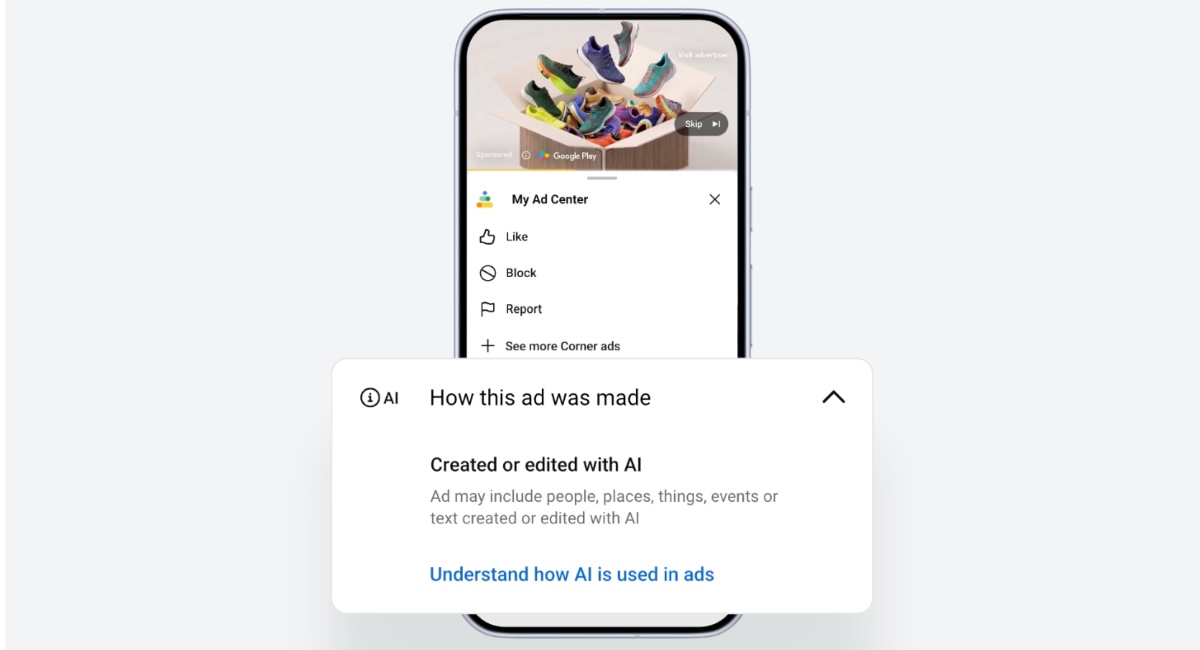
On 9 July 2026, Google introduced a “How this ad was made” section to its My Ad Center panel, accessible by selecting the three-dot menu or info icon on ads across Search, YouTube, and Discover. The panel indicates whether an ad was created or edited with AI.

For ads built using Google’s own generative AI advertising tools, the disclosure is added automatically. For ads created using AI tools outside of Google’s platform, advertisers are required to indicate this themselves using a new control in their account settings.

For most of the world, this disclosure sits behind a menu almost nobody clicks. But for campaigns targeting the EU, India, and New York, a visible label now appears directly on the ad itself, before the audience sees what is being sold.

Where the legal exposure sits

This is the part that matters for small business owners running Google Ads with AI-generated content.

Google has been explicit: its label setting does not guarantee your compliance with local laws or regulations. The platform will surface the disclosure mechanism. Whether you use it correctly, and whether your ads meet the legal standards in the markets you are targeting, is your responsibility.

Two pieces of legislation are driving the urgency right now.

New York’s synthetic performer law came into effect on 9 June 2026. It requires a conspicuous disclosure when an ad features an AI-generated human likeness. The obligation sits with the advertiser or the agency, not the platform serving the ad.

The EU AI Act’s deepfake disclosure rules take effect on 2 August 2026. Penalties for non-compliance run up to 15 million euros or 3 per cent of global annual turnover, whichever is higher.

For Australian businesses advertising into these markets, these are not distant regulatory concerns. They are live obligations with real penalties attached.

What a visible AI label actually costs you

Beyond the compliance question, there is a commercial one that nobody yet has clean data on.

Donatas Smailys, CEO of Billo, the largest creator marketing platform in the United States, argues the disclosure regime forces brands to confront a question they have been able to avoid until now: which parts of their creative actually benefit from AI, and which parts now carry more risk than they are worth.

“Nobody yet knows what a visible ‘made with AI’ tag does to conversion on a cold audience. Nobody has clean conversion data on what a visible AI label does on Google’s surfaces, the label only started rolling out this month,” Smailys said.

He identifies three costs that an AI-generated ad now carries that a human-made ad does not.

“A synthetic ad now carries three costs a human one doesn’t. A disclosure obligation, a label your audience may or may not react to, and a legal exposure that sits with you rather than with the platform serving it. So the brands need to reevaluate where and how AI actually brings them value and speed. And where it just creates more risks and problems,” Smailys said.

For small businesses, that is a useful frame. AI in advertising is not categorically risky. But using it without understanding where the disclosure obligations sit and how your audience might respond to a visible label is now a more expensive mistake than it was three weeks ago.

What to do before August

The practical checklist for small business owners running Google Ads right now is straightforward.

First, audit your current ads for AI-generated content. If any creative was produced or edited using an AI tool, including image generation, voice synthesis, or AI-generated human likenesses, check whether you have disclosed this in your Google Ads account settings.

Second, if you are targeting audiences in the EU, New York, or India, treat disclosure as non-negotiable and get legal clarity on what conspicuous disclosure means in practice for your ad formats. The EU AI Act deadline of 2 August is weeks away.

Third, if you are using AI to generate human likenesses in your ads, whether faces, voices, or both, the legal exposure is highest in this category. This is where New York’s synthetic performer law is most directly applicable and where the EU rules are most stringent.

Fourth, do not assume Google’s automatic disclosure tools cover your compliance obligations. Google has said plainly that they do not. If you are uncertain about your obligations in a specific market, that uncertainty is worth resolving with a legal adviser before August, not after.

The broader shift here is one small business owners running digital ads need to absorb: AI-generated ad creative is no longer just a production choice. It is a compliance category. The platform serving your ads will flag it. Whether you have handled the legal side of that flag is up to you.

Keep up to date with our stories on LinkedInTwitterFacebook and Instagram.

Yajush Gupta

Yajush Gupta

Yajush writes for Dynamic Business and previously covered business news at Reuters.

View all posts