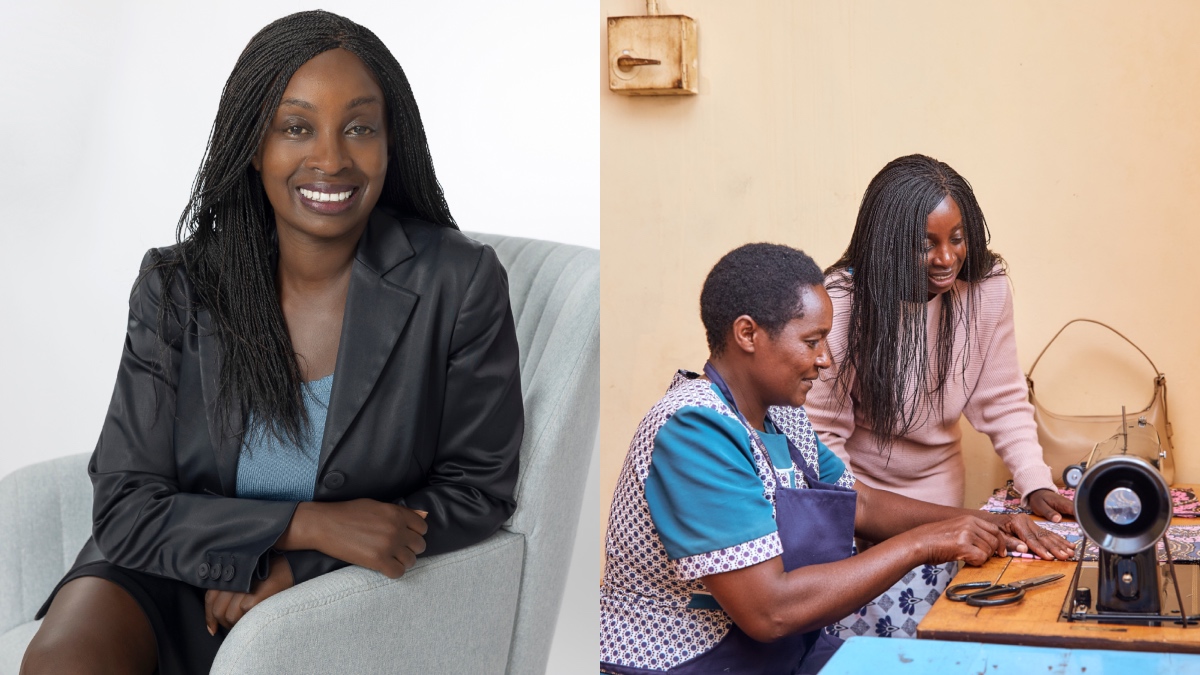
This week on Founder Friday, we sat down with Angela Magut, the founder of Miriam Bella, a small batch shoe brand handcrafted in rural Kenya by women
“I didn’t set out to start a fashion brand. I wanted to create opportunity and show what’s possible when women are given the chance to thrive.”
Angela Magut was not looking for a business idea when she found one. She was looking at what was happening to the village where she grew up in rural Kenya, trying to figure out what she could do about it. The land families had farmed for generations was shrinking. The jobs were disappearing. Children were dropping out of school. And a woman she had known her whole life was watching her grandson’s future narrow in ways that felt both sudden and inevitable. Angela was living in Melbourne, working in corporate tech, and carrying that story with her. It took her seven years to stop analysing and start building.
What she built was Miriam Bella, a handcrafted footwear and accessories brand made in rural Kenya by women who needed work and found, in a repurposed factory and a set of entirely new skills, something that changed their lives. This week on Founder Friday, Angela talks about what it took to get started, what surprised her when she did, and why some of her shoes only exist in 54 pairs.
A village, a story and a seven-year idea
The story of Miriam Bella begins not in a design studio or a business accelerator, but in a conversation Angela Magut kept having with her father from the other side of the world.
“I would talk to my Dad and he would tell me about how terrible the situation was back home in the village,” she says. Her father had been the main employer in Lelmokwo, the small rural community in Kenya where Angela was born and raised. When he retired, the work that had sustained the village went with him. Angela had left at nineteen to study computer science in Perth, and later built a corporate career in Melbourne, but she returned regularly. Each visit told the same story in sharper relief.
“One story in particular stuck with me,” she says. “There was a lady who used to look after my youngest sister. She was telling me that her grandson had to drop out of school because they couldn’t afford his school fees, and her daughter had lost her casual job. They were living in poverty.” Fifteen years earlier, that family would have managed. The land and the work had been enough. By the time Angela heard this story, neither was.
She started asking herself what she could do. Not in an abstract way, but practically. She had a background in technology, not fashion. She had a life in Melbourne, not Nairobi. But she had also been sitting with this question for seven years, turning it over and doing nothing, trapped in what she now calls analysis paralysis. “I had been thinking about starting Miriam Bella for about seven years, but I did nothing because I was analysing and analysing everything,” she says. “When I eventually started, I realised that my thoughts were very different from what eventuated. The reality was very different from the scenarios I had built up in my head.”
The thing that finally moved her was a World Bank paper on the leather industry in East Africa. It recommended Kenya improve its tanneries to produce and export high-end leather goods. Angela read it and felt the pieces connect. Kenya’s leather was already good. Some of the country’s tanneries had been upgraded under a Ministry of Industrialisation program to the point where they were supplying major European luxury brands. If the raw material was that quality, the finished product could be too.
“I thought this idea had potential, so I went to RMIT school of fashion and learnt how to make shoes,” she says. “I started researching where I could source all the components and how I could bring this idea to life.” She spent three years in that process: refining designs, creating samples, ordering materials, understanding the supply chain from the village to the customer. She brought in shoemakers to train up women in the community, repurposing one of her father’s old factory buildings to do it.
It was not straightforward. “The community is so patriarchal,” she says. “The women kept saying ‘No! This isn’t a job for me!’, but they learnt quickly.” The resistance was real, but so was the capability once the training started. And Angela was deliberate about who she hired. “People would ask me, ‘why don’t you hire normal people’, but I wanted to employ the most disadvantaged, so I could upskill them and give them a chance for a better life.”
Building something nobody had done before
Miriam Bella launched officially in November 2025 with a range of handcrafted espadrilles, sandals and bags. The shoes are made with high-quality sheep leather lining and come in everything from classic neutrals to bold African-inspired prints. Every piece is made by hand in rural Kenya. Some of the limited edition styles exist in very small numbers. The Bahari Woven Tote Bag ran to thirty pieces. One espadrille print was made in just 54 pairs. “We make every single piece by hand, hand beading and pouring love into these beautiful products,” Angela says. “Some of our limited-edition products, like our Bahari Woven Tote Bag, we only made 30, so they are genuinely exclusive.”
The business currently employs fifteen artisans in Kenya, eight of whom are women. Angela also runs literacy classes at the factory to teach workers English, and the impact she describes is already significant. One woman has used her earnings to pay for her daughter to attend university, where she is studying nursing. Nine girls have been supported to stay in school. More than twenty-five households have been transformed. Emily, one of the artisan beaders, has been able to invest in livestock. For a single mother in rural Kenya, that is not a small thing. “When I paid school fees with my own money for the first time, I cried. I felt so proud,” Emily says.
What the business has made possible
“When I paid school fees with my own money for the first time, I cried. I felt so proud.”
For Angela, the business and the community impact were never separable. “I didn’t set out to start a fashion brand,” she says. “I wanted to create opportunity and show what’s possible when women are given the chance to thrive.” That framing sits at the centre of everything Miriam Bella does, from the deliberate small-batch production runs to the training programs to the way the brand communicates with its customers. Buying a pair of shoes is, by design, also buying into something larger.
Looking back, the lessons Angela names are less about product and strategy than about the personal architecture of building something from scratch. She talks about the importance of finding mentors early, of seeking out communities like the Swinburne Social Impact Accelerator, which she credits with validating Miriam Bella before it existed as anything more than an idea. She won an award through that program for most impactful business idea, and she describes what that moment meant: “Having that validation in a group of around thirty people was very important for me. It made me think there is actually something here.”
She talks about the burnout risk of being a solo founder while holding down a full-time corporate job, and the discipline she had to learn around protecting her own time. “Your task list is never going to be completely done, so it is important to protect your own wellbeing as well,” she says. “I learned the importance of making time for exercise, rest, and fun because when you are building a business, there is always more work that could be done.”
And she comes back, again, to the seven years she spent not starting. It is the thing she most wants other founders to hear. “If you are itching to do something, just do it,” she says. “You just need to get started.”
The three pieces of advice she would give anyone thinking about building something: talk to supportive people about your ideas, seek mentors as early as possible, and carve out time for yourself. Because the work, she says, never completely stops.
Keep up to date with our stories on LinkedIn, Twitter, Facebook and Instagram.