
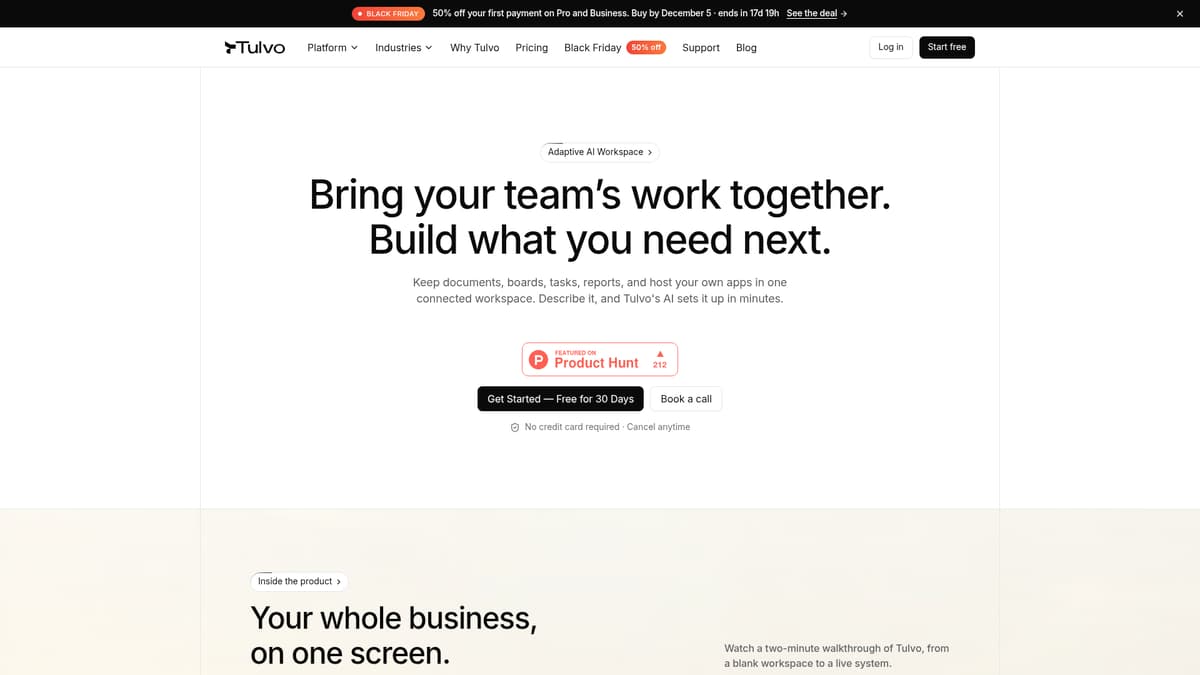
Tulvo is an all-in-one adaptive AI workspace designed to unify documents, databases, boards, reports, apps, and website hosting into a single system. It addresses the common challenge of using multiple specialized tools by enabling business owners and teams to describe workflows or systems in plain language—such as a CRM, applicant tracker, or inventory pipeline—and letting Tulvo AI build the data structure, interfaces, content, and reporting automatically. It also supports hosting custom apps and websites without separate backend infrastructure, aiming to reduce complexity and tool sprawl while maintaining real-time data coherence.
Key Features
AI-driven workspace building: Users can describe what they need, such as “build a hiring pipeline with stages” or “create a client tracker,” and Tulvo generates the data model, boards, templates, and documents automatically. The newly introduced Tulvo MCP (Model Context Protocol) allows external AI agents like ChatGPT, Claude, Grok, or Cursor to build docs or websites directly inside the Tulvo workspace. MCP is currently in beta and available on all plans.
Unified content types: Tulvo supports rich documents, boards, reports, and data templates. Boards can be displayed in Kanban, grid, or list views, all connected to shared underlying data, so changes update across dashboards and content consistently.
Publishing and website/app hosting: You can publish documents to share via a public URL, monitor who viewed them, and host custom apps built elsewhere like with Lovable, ChatGPT, or Claude, connecting them to Tulvo’s data without needing separate servers.
Automations, integrations, and permissions: Tulvo offers built-in automations, webhook support, custom permissions, guest access, page analytics, and integrations with tools like Slack, Notion, Google Sheets, GitHub, and more.
Versioning and history: Depending on the plan, version history of pages is retained for 7, 30, 90 days, or unlimited in enterprise plans. Storage and block limits vary by plan, and plans also include features like priority support and custom domain inclusion.
Transparency and oversight: Tulvo publishes AI use disclosures, subprocessors including OpenAI for AI/LLM processing, and policies clarifying that its AI output can be inaccurate and should be reviewed before relying on it. Tulvo AI is a productivity tool, not a legal or professional decision-maker.
Pricing
Tulvo offers a tiered pricing model with four main plans: Free, Pro, Business, and Enterprise. All paid plans include a 30-day free trial and a 30-day money-back guarantee.
Free — Free forever, no credit card needed. Includes unlimited docs, reports, boards, and workspaces; limits are 1,000 blocks per workspace, 1 GB of storage, 2 deployed apps, 3 GB monthly app bandwidth, and up to 5 guests. 7-day page history.
Pro — $15 per member per month, or $12 per member per month when billed yearly. Adds unlimited blocks, 20 GB storage, 10 GB app bandwidth per month, up to 10 deployed apps, custom domain, integrations and webhooks, custom permissions, page analytics, 30-day history, and priority support.
Business — $25 per member per month, or $20 per member per month when billed annually. Adds higher limits: 100 GB storage, 50 guests, 25 GB app bandwidth per month, 50 deployed apps, 90-day page history, ability to purchase extra bandwidth, and monthly spending caps.
Enterprise — Custom pricing tailored to large organizations. Offers white labeling, custom file size, storage, bandwidth and guest limits, unlimited page history, dedicated onboarding and support.
Guests are not counted as paid seats. Limits apply mainly to blocks, apps deployed, storage, bandwidth, and guest numbers based on the chosen plan.
Who Is It For?
Tulvo is well suited for business owners, professionals, and decision-makers who:
Oversee small to midsize teams facing tool fatigue due to using multiple specialized apps for docs, project tracking, and reporting. Tulvo can consolidate tools like CRMs, wikis, site builders, and dashboards into one platform.
Need to launch or maintain client-facing apps or simple public websites without managing backend infrastructure or hosting separately.
Rely on external AI assistants such as ChatGPT or Claude and want them to act directly on their workspace data for writing, editing, or building content via MCP.
Require customizable workflows and data models, but want to avoid heavy engineering or setup effort. For example, HR managers tracking hiring pipelines, operations leads consolidating inventory or supply chain data, or agencies managing client intake and content publication.
Need version control, permissions, and publishing features for internal docs or external content with analytics.
It is not ideal for organizations that require very high compliance, detailed export guarantees, or specialized integrations currently outside Tulvo’s ecosystem, or those who need elaborate enterprise-grade security or offline capabilities without evaluating limits and policies first.
Final Thoughts
Tulvo presents a well-rounded dashboard for businesses that want to centralize their digital workflow tools into a single, AI-assisted system. Its ability to generate custom data models and dashboards from natural language, coupled with app hosting and publishing, offers a compelling alternative to stitching together multiple platforms. Free and Pro plans provide strong entry points for individuals and small teams, while Business and Enterprise tiers are equipped for greater scale and custom requirements. As with any AI-driven tool, human oversight remains essential, particularly where accuracy, privacy, or compliance are critical considerations. Overall, Tulvo is a promising option for teams seeking to streamline their operational stack without sacrificing flexibility.
Visit the official website for more.
Keep up to date with our stories on LinkedIn, Twitter, Facebook and Instagram.