
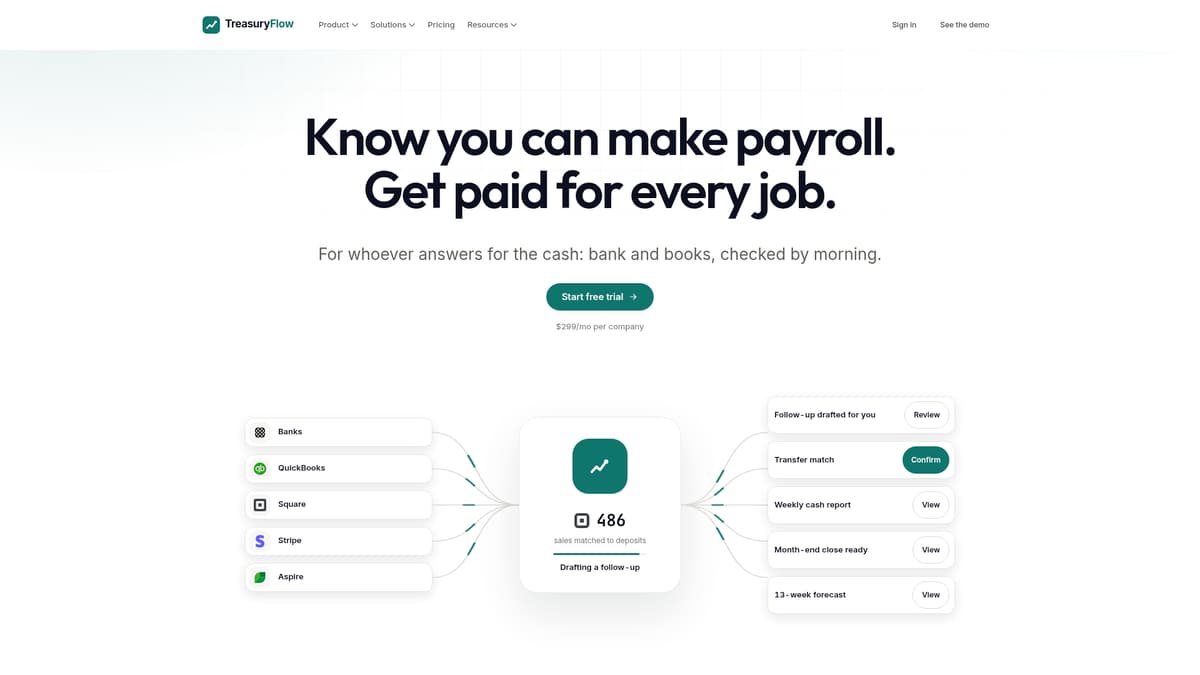
TreasuryFlow is an AI-powered financial management tool designed to give growing businesses real-time visibility into their cash position, bank reconciliations, and forecasts by drawing directly from bank data rather than relying on manual entries or lagging accounting software. It works as a live “CFO cockpit,” consolidating accounts via read-only bank feeds, producing a double-entry general ledger that reconciles to the bank balance, and regenerating 13-week cash forecasts daily—all aimed at reducing manual effort and uncertainty in cash planning.
Key Features
Live bank integration via Plaid: TreasuryFlow connects to over 10,000 financial institutions across the United States and Canada, pulling in cleared transactions daily so cash balances reflect actual bank activity.
AI-powered categorization: Transactions are automatically categorized in alignment with the chart of accounts you already maintain. Any transaction the AI cannot categorize with high confidence is quarantined to a suspense account until reviewed.
Deterministic general ledger: From the bank feed, a double-entry ledger is constructed automatically; debits always equal credits, and every figure can be traced back to cleared bank transactions.
13-week rolling cash forecast: Updated each morning, the forecast separates recurring inflows and outflows from one-off events, helps monitor cash floors, and projects runway to support financial planning.
Job costing and operations integrations: TreasuryFlow supports integrations with tools like Aspire, Square, Stripe, Toast, Gusto, and others to incorporate revenue, payroll, or job-level insights into forecasts.
Multiple delivery formats: Users can access reporting via a web portal, receive a daily morning brief via email that highlights what has changed overnight, and use an Excel add-in to bring live balances, categorized transactions, and forecasts into spreadsheets they already use.
Read-only, audited, and compliant: The tool is built on SOC 2 infrastructure; bank access via Plaid is read-only, no automatic writes back to accounting systems; audit logs, private infrastructure, and security controls are core design elements.
Pricing
TreasuryFlow offers a predictable, flat pricing model with two main tiers:
Base Plan: $299 per month per company, which includes access to all core features like live bank data, 13-week forecasts, the general ledger that ties out to the bank, unlimited bank accounts and team seats, the daily morning email, Excel exports, and integrations with supported systems. This plan comes with a 90-day free trial.
Operator Plan: $499 per month per company. This tier is aimed at businesses needing job costing and more advanced operational tracking. It includes everything in the base plan plus enhanced tools for job profitability, sub-company or entity grouping, and operational integrations in more complex settings.
Who is it for?
TreasuryFlow is especially well suited for small to mid-sized businesses generating between approximately $1 million and $20 million in revenue—particularly those with multiple bank accounts, regular payroll, vendors, or contracts where cash flow timing is business-critical. Financial professionals and business owners who currently spend significant time reconciling bank statements, updating spreadsheets, or waiting on accounting software updates will benefit most. Fractional CFOs and accounting or advisory firms overseeing several clients will also find value in consolidated dashboards and the portfolio view. Industries that involve project-based work, such as construction, landscaping, or service operations, can leverage the job-costing features to understand profitability per job and manage resource allocation more precisely. Companies already using QuickBooks Online will benefit more immediately due to full integration; while support for Xero is built but not fully enabled yet.
Final thoughts
TreasuryFlow presents a strong value proposition for growth-stage companies looking to trade spreadsheet tedium for real-time clarity in cash flow and bank reconciliations. Its deterministic approach to ledger construction, along with frequent forecasting and deep integrations, offers a level of trust and precision often missing from lagging accounting systems. With a flat pricing model, tools for both basic and more advanced operational scenarios, and strong security and compliance foundations, it is worth evaluation for businesses for whom cash visibility isn’t just a convenience—it’s a necessity. For those with simpler cash flows or limited volume of accounts and transactions, the full power of TreasuryFlow might be more than required, but the tool scales up well as complexity grows.
Visit the official website for more.
Keep up to date with our stories on LinkedIn, Twitter, Facebook and Instagram.