
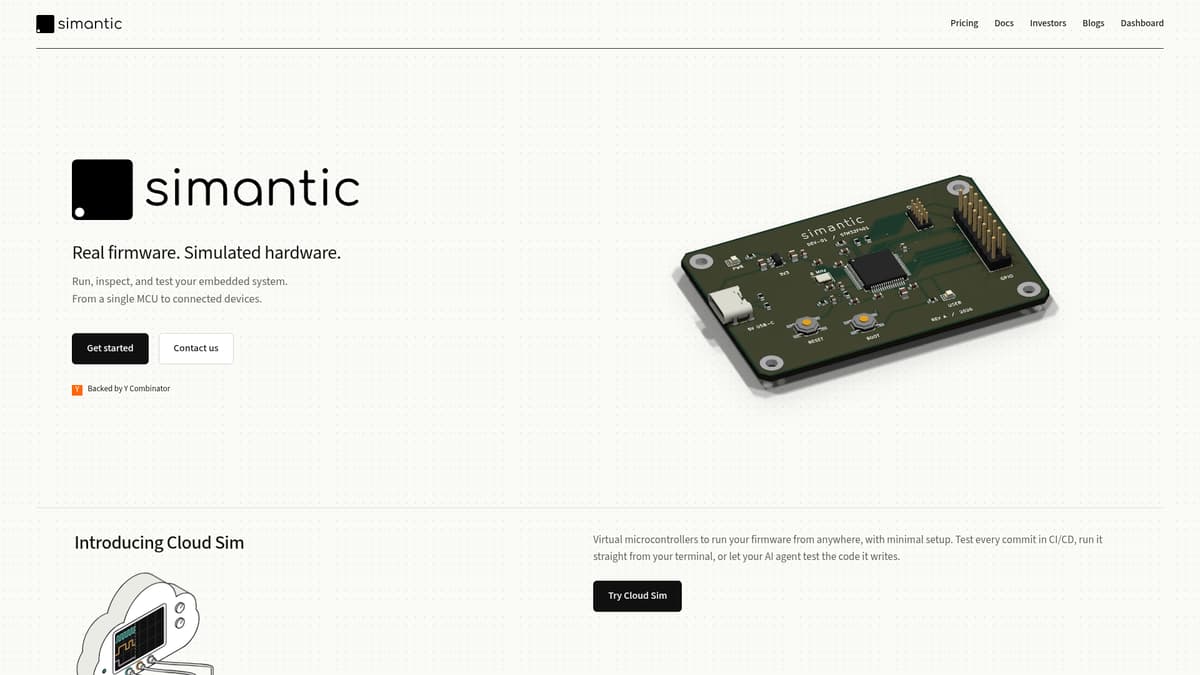
Simantic is a simulation and testing tool designed for embedded firmware development that enables engineers to test real firmware on virtual microcontrollers without needing physical hardware. It resolves delays common in firmware development workflows such as waiting for prototypes, debugging on hardware benches, and limited observability by allowing developers and AI tools to build, simulate, and validate firmware changes automatically.
Key Features
Simantic enables developers to run firmware ELF binaries against virtual microcontroller models with complete peripheral and core simulations. You can inspect registers, threads, and runtime behavior while the simulation runs. Observability extends into interrupts, timing, and memory use, areas often hard to debug on hardware alone. The same simulation environment integrates into CI/CD pipelines, offering predictable, repeatable runs.
The tool supports injecting external stimuli: sensor readings, CAN, Ethernet, and Bluetooth Low Energy traffic can be simulated. A GitHub-integrated workflow includes a bot that builds firmware pull requests, generates test scenarios from code diffs, runs those scenarios in simulation, and reports mismatches in expected versus actual behavior. This helps catch bugs related to peripheral interactions or timing before code reaches hardware stages.
Simantic provides both cloud-based simulation, Cloud Sim, and a local CLI tool to run simulations for supported chip models. The local option works on Apple Silicon and x86-64 Linux, with macOS support and Windows via WSL2, though not every peripheral or MCU model is fully implemented. A Python SDK in alpha allows scripting tests or embedding simulation logic in test suites.
Pricing
Simantic offers three main pricing tiers: Community, Developer, and Enterprise.
The Community plan does not publicly list its subscription cost. It includes a small monthly credit allowance and allows up to 3 concurrent simulations. Developers who require more capacity can opt for the Developer plan, priced at about $100 per month or $1,000 per year before tax, which includes more monthly credits and allows around 10 concurrent simulations. The Enterprise level is custom-quoted; it offers unlimited API usage, unlimited simulation concurrency, private hosting, and additional support or hosting options.
Who is it for?
Simantic is best suited for hardware and firmware engineers who work in embedded systems, including devices like sensors, wearables, industrial controllers, robotics, or any system with multiple microcontrollers. When hardware prototype availability is limited, or when bench debugging is expensive, Simantic’s virtual environments allow early-stage testing and verification.
Teams using GitHub for version control benefit from integration with pull request workflows: Simantic Bot can provide actionable feedback before code enters hardware or production CI, reducing downstream defects. Companies with continuous integration practices or regulatory requirements where firmware behavior needs documentation and reproducibility will especially appreciate Simantic’s trace-based testing and scenario generation.
AI agents or tools that generate firmware code also benefit: Simantic makes it possible to test generated firmware automatically, avoiding hardware accidents or misconfigurations before flashing devices. Early-stage startups in hardware or firms scaling embedded development pipelines tend to see the most return.
Final thoughts
Simantic bridges a common gap in firmware development by providing simulated hardware environments that make behavior visible, testable, and reproducible without physical devices. It shines in catching issues that code review alone often misses, like timing, peripheral behavior, and runtime memory. While the Community plan offers useful trial capacity, teams with more complex or high-stakes needs will likely require Developer or Enterprise tiers to unlock useful concurrency and unlimited usage. For businesses building embedded or IoT devices, Simantic can be a powerful addition to reliability, speed, and developer confidence.
Visit the official website for more.
Keep up to date with our stories on LinkedIn, Twitter, Facebook and Instagram.