
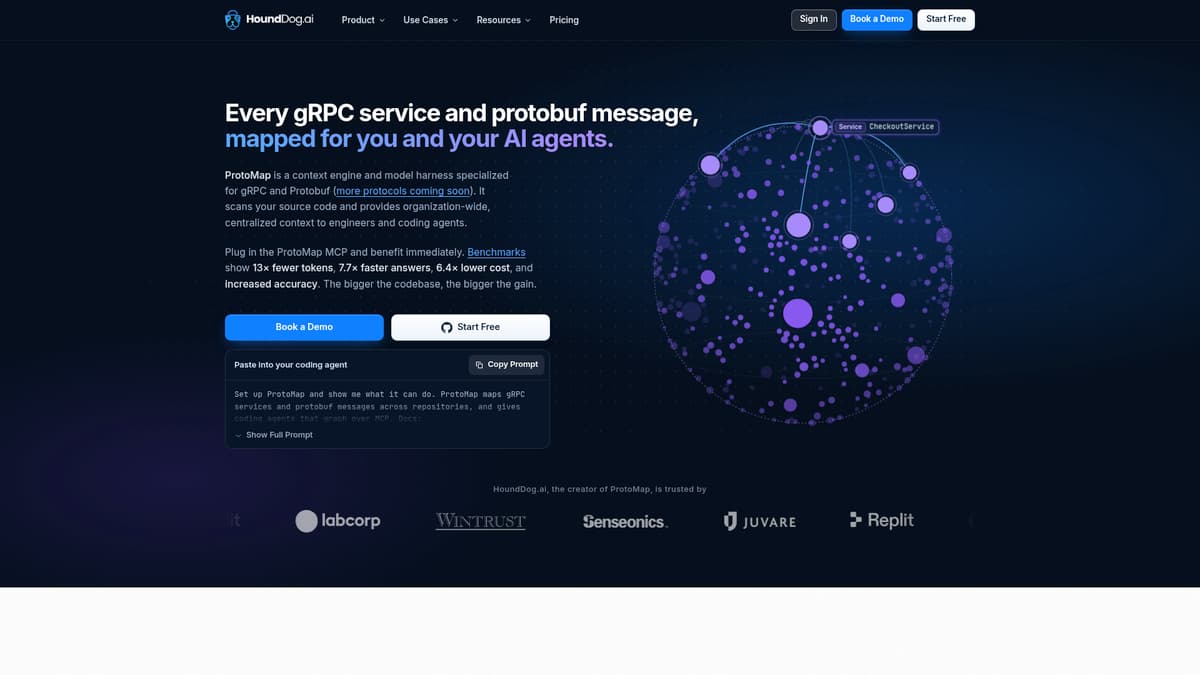
ProtoMap is a tool from HoundDog.ai designed to help engineering teams and AI coding agents manage complexity in large gRPC and Protocol Buffers (protobuf) codebases. It builds a deterministic service graph mapping services, RPC methods, message fields, callers, and call sites across repositories, enabling faster change planning, dependency tracing, and improved cost efficiency by eliminating repeated context discovery.
Key Features
Deterministic service graph for gRPC/Protobuf systems: ProtoMap automatically extracts relationships across services, APIs, and protobuf fields. It tracks which services call which, and which messages are exchanged, using static analysis so that every commit yields a consistent view.
It does not use AI for detection of service relations; AI is used optionally for interpreting and querying results.
Works out of the box with languages such as Go, Java, C#, Kotlin, Python, Rust, Swift, TypeScript, and JavaScript.
Scans .proto files and identifies consumers and call sites across monorepos or microservice landscapes.
No build step or compiler is needed for detection; the scan reads source files directly.
Support for engineers and AI coding agents via MCP: Queries can be made in plain English via a web assistant or directly from AI coding agents over the Model Context Protocol (MCP). This facilitates collaboration between human engineers and autonomous agents without duplicating discovery tasks.
Blast-radius and dependency analysis: Useful for assessing current or planned changes, such as renaming a field, modifying service behavior, or deprecating RPCs. ProtoMap shows multi-hop dependencies, call paths, and all call sites impacted. It also identifies unused or orphaned RPCs.
Continuous scanning and integration with CI: For enterprise use, scans run in CI pipelines and update service graphs on every commit or pull request; integrates with platforms like GitHub, GitLab, and Bitbucket. Cloud or on-premises deployment options help ensure security, compliance, and consistency.
Benchmarked improvements: In tests across nine large gRPC repos, ProtoMap achieved around 6.4× faster responses and 5.3× cost reductions for prompts when using an AI coding agent through MCP, without compromising accuracy. It also cuts token usage significantly.
Security and deployment: Runs locally or fully self-hosted on-premises for enterprise customers. The self-hosted platform includes a web UI, CLI scanner, and Docker Compose-based architecture. Moreover, code never leaves the organization's infrastructure under both free local and enterprise use.
Pricing
Free (local use / individual developer): ProtoMap can be installed on a local machine. For individual developers or small teams scanning code locally, the tool is available at no cost. The local scanner produces API graphs and supports MCP-compatible agents.
Enterprise tier: For organization-wide deployment and continuous scanning across many repositories, live CI integration, hosting in cloud or on-premises, GitHub, GitLab, and Bitbucket integration, advanced security features such as SOC 2, audit logs, RBAC, and SSO, plus centralized governance. Pricing for Enterprise is available via quote and depends on the number of contributing developers.
For related tools: Similar structure applies to Privacy Code Scanner and Dataflow Context Engine — free for local, point-in-time scanning; enterprise plans with broader integrations and compliance-related features are priced at $200 per developer per year for the Privacy Code Scanner enterprise tier. For the Dataflow Context Engine, enterprise pricing is custom.
Who is it for?
ProtoMap is best suited to organizations and roles where gRPC-based microservices architecture, protobuf messaging, or large monorepo setups are common. Its strongest fits include:
Platform engineering and developer productivity teams tasked with maintaining reliability and consistency across complex service landscapes. ProtoMap helps reduce the risk of breaking changes by clarifying dependency paths and impact zones.
AI engineering teams or organizations using AI coding agents, particularly those compatible with MCP. They benefit from reduced token usage, faster prompt resolution, and less duplicated discovery work.
Firms in regulated industries such as finance and healthcare, or organizations with strong compliance requirements. They may need audit trails, precise provenance of API usage, service ownership, or field-level governance; ProtoMap offers deterministic context and on-premises or cloud deployment with compliance controls.
Organizations facing frequent refactors, schema changes, or looking to retire unused services or fields. ProtoMap can help find dead RPCs or unused fields reliably.
Developers or smaller teams wanting to try out context mapping or API graphing locally before scaling to enterprise-wide deployment.
ProtoMap is less critical for very small codebases without gRPC or protobuf, or when services are trivial in number or scope, where the overhead of setup may outweigh the benefits.
Final thoughts
ProtoMap offers a strong, technically well-founded approach to reducing friction and risk in complex service-of-services codebases. Its deterministic static analysis, MCP connectivity, and enterprise features address persistent pain points around context discovery, burst cost, and schema governance. Combined with its free local tier, it enables experimentation while offering scalable paths for large-scale use. For organizations building with gRPC and protobufs, especially those integrating AI coding tools, ProtoMap is a tool worth evaluating seriously.
Visit the official website for more.
Keep up to date with our stories on LinkedIn, Twitter, Facebook and Instagram.