
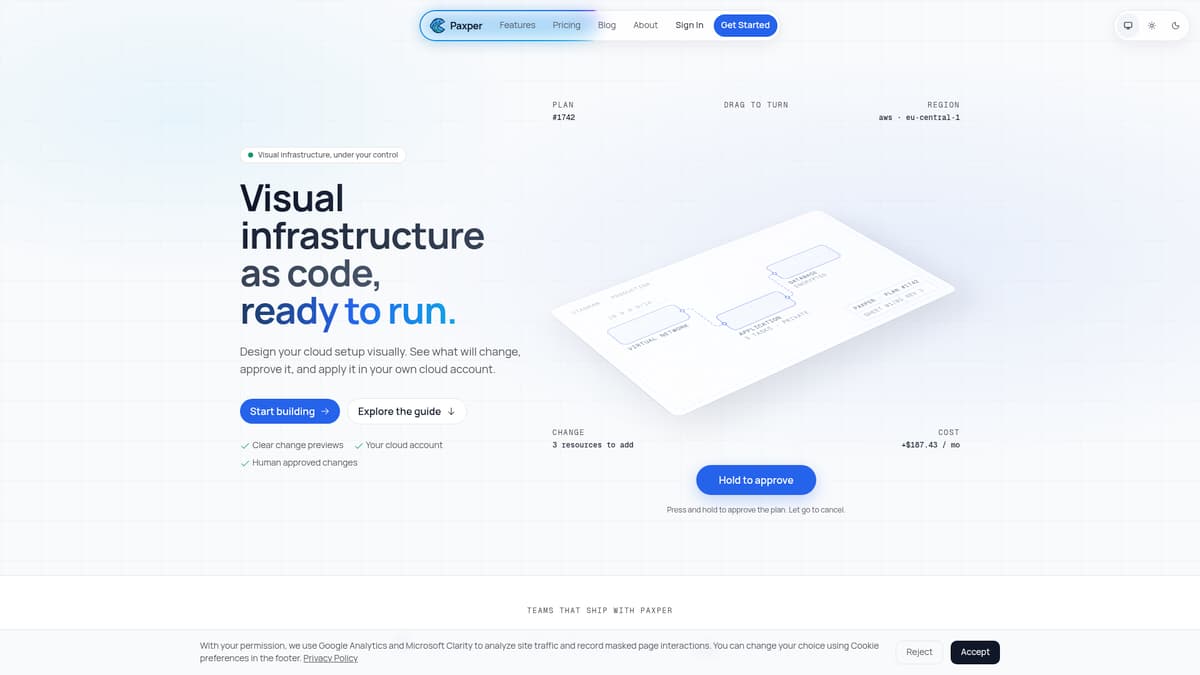
Paxper is a cloud infrastructure tool designed to simplify the design, planning, and management of Amazon Web Services (AWS) resources through a visual canvas. It turns graphical diagrams into infrastructure-as-code configurations, enabling teams to visually architect their environments, preview changes, including cost impacts, before applying them, and track drift between the diagram and deployed infrastructure. Paxper integrates built-in AI to assist during the design and troubleshooting processes.
Key Features
Visual design: Users build infrastructure diagrams using a drag-and-drop canvas. Resources are added with their dependencies already connected, templates are available for common setups, and values such as instance types or AMI IDs load dynamically from the user’s AWS account. Live validation helps prevent misconfigurations.
Safe change workflows: Every change begins with a plan that shows what resources will be created, modified, or destroyed. Workflows include manual approval, live console feedback during apply, version history with restorations, drift detection, and state locking.
Cost and operational insights: Before applying changes, Paxper estimates monthly cost per resource. After deployment, it pulls actual AWS costs via AWS Cost Explorer. Monitoring, alarms, activity feeds, and notifications help operational visibility.
AI assistance: The tool includes Paxy, an AI assistant integrated onto the canvas to help design and modify infrastructure. AI Analyze explains failed jobs and suggests fixes. Additional AI assistants, such as Claude, can connect via an MCP server to interact with workflows.
Security, governance, and team controls: Paxper supports role-based access, encrypted credentials, two-factor authentication including passkeys, IP allowlists, audit logs exportable as CSV or JSON, and restriction of cloud credential usage per workspace. Sandbox environments can isolate experimental projects outside production.
Cloud provider support: Full AWS support is available today. Support for Microsoft Azure, Google Cloud Platform (GCP), and Oracle Cloud is listed as coming soon.
Pricing
Paxper offers a freemium pricing model with three tiers: Free, Team, and Enterprise.
Free: No cost per user per month, includes unlimited projects, one workspace, one cloud provider, and one apply per project. Users get AI credits, and support is provided via community channels.
Team: Priced at $49 per user per month, or $490 per user per year. Includes two workspaces; additional applied workspaces beyond the first two cost approximately $50 per workspace per month. Unlimited applies are included under the Team plan. Email support with standard SLA is included.
Enterprise: Custom pricing, offering unlimited workspaces, features like single sign-on (SSO), audit trail, dedicated on-call support, and migration assistance. Details are provided on a case-by-case basis.
AI-related features consume AI credits, which are included free with each plan in some amount; users can purchase additional credit packages, including Starter, Basic, Pro, and Enterprise, when needed. Purchased credits do not expire.
Who is it for?
Paxper is best suited for small to medium-sized engineering teams working primarily in AWS who prefer visual tools over writing code for infrastructure changes. It addresses key challenges for those who want to reduce the risk of drift, improve visibility into costs before deployment, and add a human review or approval gate to infrastructure modifications. Decision-makers, such as DevOps leads, infrastructure engineers, and CTOs, who need higher transparency and control without building a full infrastructure-as-code pipeline around tools like Terraform or OpenTofu may find Paxper especially helpful.
It is less suited for organizations already deeply invested in text-based IaC workflows, such as Terraform or CDK, companies operating across multiple clouds today, or environments needing immediate import of existing infrastructure, a feature that Paxper is working toward but has not yet released. It is also new to market, so teams concerned about maturity, long-term support, or edge-case stability may want to pilot before full adoption.
Final thoughts
Paxper offers a compelling visual approach to cloud infrastructure management that fills a gap between manual console workflows and full-code IaC pipelines. Its plan-preview-before-apply, cost estimation per resource, and built-in AI support reduce guesswork and risk. While limited today to AWS and still maturing, the Free and Team tiers provide accessible entry points for businesses to test its value. For teams seeking greater clarity, control, and collaboration in cloud infrastructure changes without immediately committing to code-first tools, Paxper may merit serious consideration.
Visit the official website for more.
Keep up to date with our stories on LinkedIn, Twitter, Facebook and Instagram.