
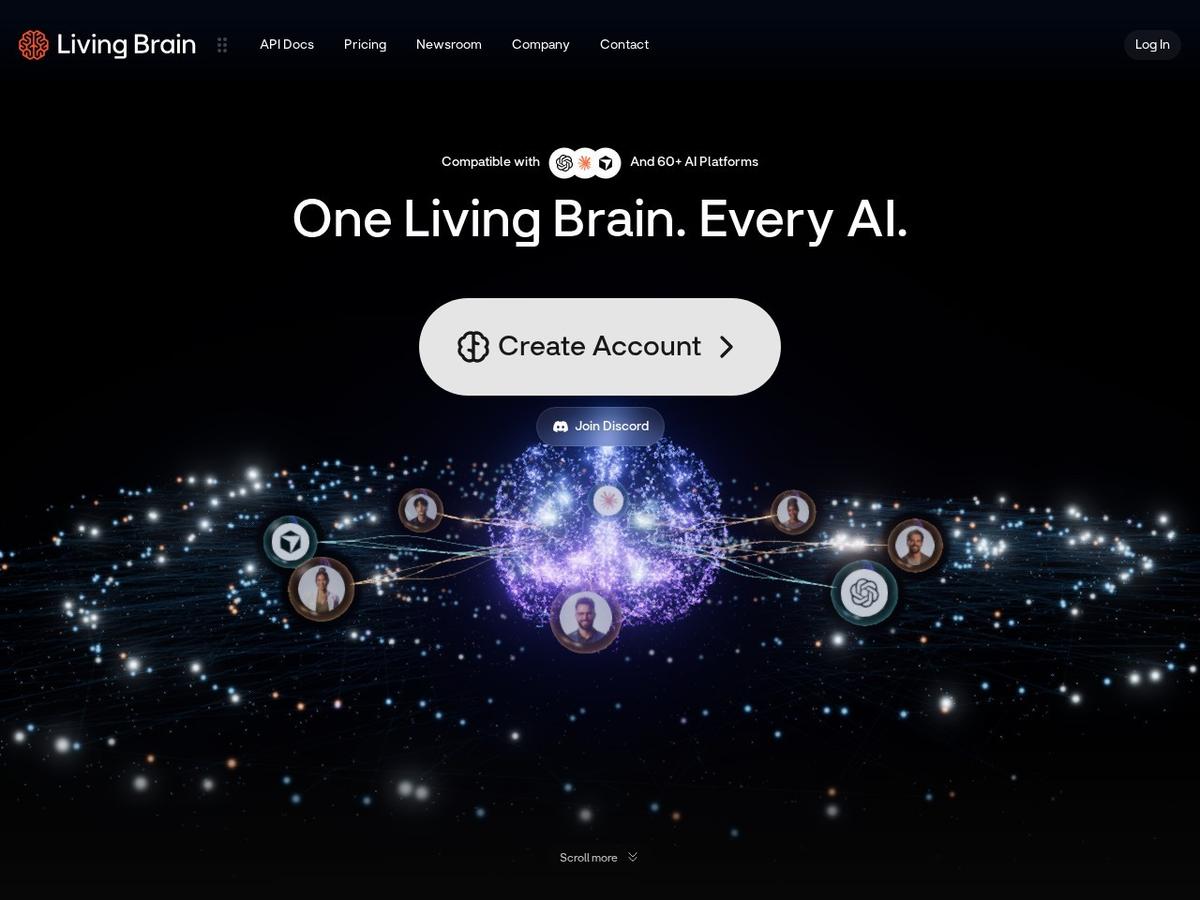
Living Brain is a knowledge memory layer designed to enhance the performance of AI agents and applications by storing and organizing team knowledge external to any specific model. Rather than constantly loading large context windows or rebuilding context from scratch, Living Brain captures conversations, documents, code, and ideas into connected memory that agents can access via REST APIs, SDKs, CLI tools, or via MCP (Model-Connected Protocol) links. The result is faster, more accurate, and more contextually consistent AI work across tools.
Key Features
Persistent, evolving knowledge vault: captures data continuously—from chats, documents, meetings—and organizes it into pages linked by semantic and lexical relationships. Memory isn’t just stored; it’s automatically compiled, summarized, and curated for relevance.
Integration with agents and tools: works with popular language models like ChatGPT and Claude, and coding tools such as Codex, Cursor, and others that support MCP. Developers can use APIs, SDKs, or CLI to plug their agents into the same memory so behavior, decisions, and learned rules carry over.
Memory health metrics: scores such as Freshness, Strain, and Readiness guide users and administrators to maintain knowledge quality, identify outdated or overburdened memory branches, and prevent degradation over time.
Cost and performance improvements: in internal benchmarks (LoCoMo and LongMemEval-S), Living Brain requires far fewer tokens per question than large full-context baselines, achieving up to 22.6× token reduction and 95% lower cost per task, while maintaining high judge-rated accuracy and low latency in retrieval and overall response times.
Pricing
Living Brain offers several pricing tiers based on usage patterns and business needs:
Living Brain API: a usage-based model for developers. Charged at $8 per 1 million input tokens and $0.50 per 1 million output tokens. Minimum top-up is $5; no monthly minimum. Includes 1 GB storage, up to 100,000 requests/month, multiple brains per project, across API, SDK, CLI, and MCP.
Living Brain Workspace: a subscription plan priced at $99/month. It’s designed for small teams with 3 seats included, 10 GB storage, 500,000 requests/month, access to version history (90 days), integrations (Slack, Telegram, webhooks), and shared credits in ChatChat Pro+.
Business (Enterprise) Plan: custom pricing tailored to organizational needs. Offers dedicated infrastructure, custom capacity, data controls, support SLAs, and deployment options (private cloud, on-premises, air-gapped, etc.).
Who is it for?
Living Brain is suited for business owners, decision-makers, and technical teams who frequently work with AI agents and want to preserve organizational memory across tools and time. It particularly benefits:
Engineering teams wanting rule consistency across code reviews and deployments; for example, when Claude and Codex agents need shared access to style rules, design documents, or policy enforcement.
Product and project managers who produce large amounts of research, roadmaps, meeting notes, and who need to find and connect that stored knowledge efficiently.
Small and medium-sized businesses that want to avoid context losses when switching platforms, onboarding new members, or using multiple AI models.
Enterprises or regulated industries where data residence, compliance, audit logs, and knowledge governance are critical. The Business plan allows for contractually defined controls.
Any professional who uses multiple AI agents over time (in chat, code, or other interfaces) and finds themselves recreating context or repeating inputs due to poor memory retention.
Final thoughts
Living Brain offers a compelling solution to a key challenge in AI-powered workflows: maintaining context over time and across tools without overloading models or incurring high costs. Its architecture, which decouples memory from models, makes it especially appealing for teams wanting shared memory, consistent rules, and improved efficiency. For decision-makers, evaluating Living Brain should include estimating expected token usage, integration overhead with existing tools, and whether the organization's complexity and scale warrant the enterprise-grade controls. When used appropriately, it has the potential to reduce redundancy, streamline collaboration, and lower AI operating costs meaningfully.
Visit the official website for more.
Keep up to date with our stories on LinkedIn, Twitter, Facebook and Instagram.