
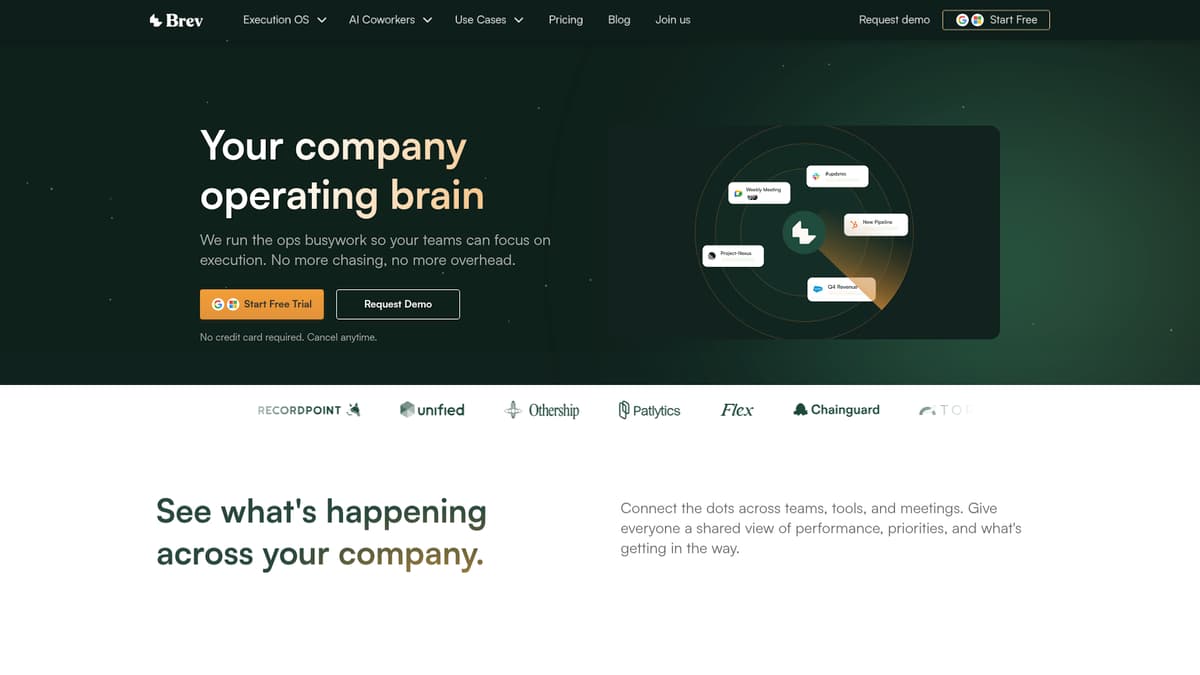
Brev is an AI-powered operations platform designed to streamline goal tracking, meeting workflows, and strategic alignment across teams. It addresses common friction in business operations—manual check-ins, disparate tools, time-consuming meeting follow-ups—by automating much of the execution work through agents and integrations. For decision-makers evaluating Brev, here are the tool’s key features, current pricing structure, ideal use cases, and an assessment of its fit for various organizations.
Key Features
Goal management and OKR support: Users can create goals, metrics (KPIs), and projects; align them in parent-child relationships; auto-track progress; score and close out time periods. Private goals, shared ownership, and weighted rollups are also available when enabled in admin settings.
Meeting agent and automations: Brev can connect to Google or Outlook calendars. A meeting agent joins recurring or selected meetings, captures transcripts, creates agendas (optional), drafts recaps, action items, and aligns meeting content to goals automatically.
Integrations with tools across workflows: Over 1,300 available integrations let Brev pull data from work trackers (Linear, Jira, Asana), CRMs (HubSpot, Salesforce), BI and data warehouses (BigQuery, Snowflake, PowerBI, Sigma), documents and spreadsheets, meeting note sources (Notion, Granola), chat platforms (Slack, Microsoft Teams), and more.
AI-powered insight and follow-up: The platform suggests insights, identifies risks and blockers, prepares recaps and digests, auto-generates check-ins or goal suggestions, and offers an AI Operator assistant for queries and context across goals.
Usage-based, credit-driven operations: Rather than charging per seat alone, Brev counts down credits when AI agents perform work—e.g. fetching data, analyzing goals, meeting-related tasks. Static or manual actions do not consume credits. Organizations can set credit caps, alerts, and monitor usage in real time.
Pricing
Free trial: New workspaces receive a one-time grant of $100 in free AI credits; no credit card is required to start.
Growth plan: Approximately $250 per organization per month. This plan is geared toward teams (rough guidance is for ten users) and includes the full core execution feature set—goal tracking, meeting agent features, meeting materials, and integration access. Native integrations, auto-prepped artifacts, goal progress tracking, and similar capabilities are part of this tier.
Enterprise plan: Custom pricing for larger organizations. Includes dedicated agents for specific workflows, advanced analytics (operating cadence dashboards, KPI alignment), embedded coaching, security and compliance features, unlimited or negotiated seat counts, and stronger enterprise support.
Note: Brev’s pricing is use-case driven (amount of agent work) rather than rigid seat-based licensing. Unused AI credits from paid plans generally do not roll over; workspaces manage credit usage via caps and alerts.
Who is it for?
Leadership teams, Chiefs of Staff, Business Operations, RevOps or BizOps professionals who need visibility into company-wide goals, KPIs, and operational cadence without relying on manual input or chasing updates.
Organizations with recurring meeting rhythms: weekly reviews, monthly business reviews (MBRs), executive syncs, OKR check-ins. Brev helps prep agendas, capture action items, and seed follow-up work automatically.
Mid-market to enterprise companies with mature tool ecosystems. If a business already uses various work trackers, CRMs, BI platforms, or document tools, Brev’s integrations can centralize execution and minimize tool switching.
Teams in fast-paced environments where speed, clarity, and alignment matter—e.g. product development, customer success, engineering leadership—especially where manual status reports, dependency tracking, and meeting overload are problematic.
Final thoughts
Brev embraces a modern operations model by treating agent-driven automation—rather than seat counts—as the primary value metric. It’s well-suited for companies grappling with the overhead of meetings, goal misalignment, and fragmented reporting. That said, its usage-based credit system requires careful monitoring to avoid unexpected costs, especially for orgs with many meetings or high AI-generated content volume. For businesses serious about stabilizing strategic execution and driving alignment, Brev offers compelling capabilities. It’s less likely to provide full value for very small teams with minimal scale or those whose workflows are manual but light enough that the automation overhead doesn’t justify the expenditure.
Visit the official website for more.
Keep up to date with our stories on LinkedIn, Twitter, Facebook and Instagram.