
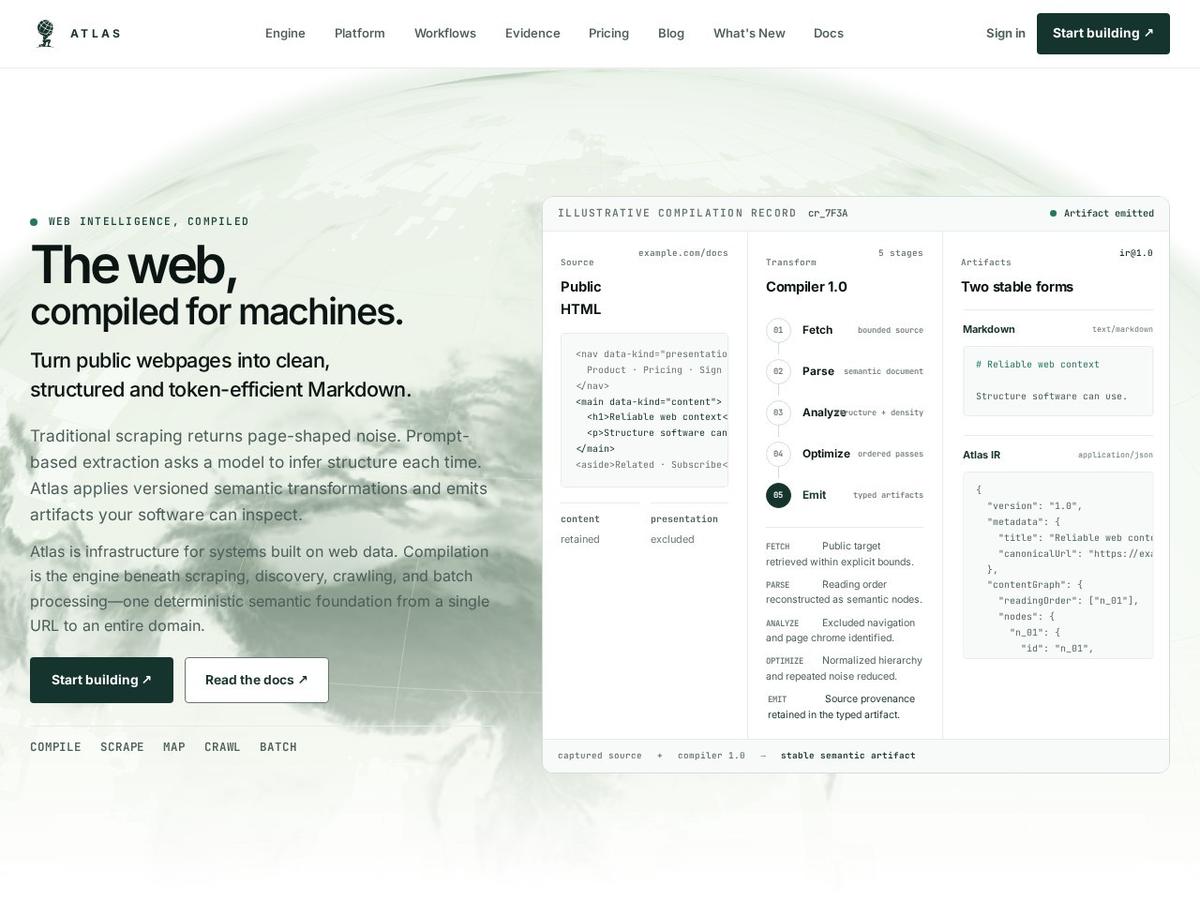
Atlas is a deterministic web intelligence infrastructure designed to turn public webpages into clean, structured, and token-efficient data. It solves the common challenge of noisy HTML and content clutter like navigation bars, ads, and tracking scripts by applying explicit transformations to produce artifacts such as readable Markdown and a typed Intermediate Representation (IR). These outputs are intended for reliable use in search, monitoring, knowledge bases, data pipelines, and AI agents.
Key Features
Deterministic compilation: Every page transforms via versioned, rule-based stages: retrieve, parse, analyze, optimize, emit. This ensures that repeated inputs under the same compiler version produce identical outputs. The system emphasizes reproducible outputs without relying on probabilistic prompt-based extraction.
Structured artifacts: Alongside human-readable Markdown, Atlas generates typed IR, preserved reading order, semantic hierarchy, and provenance back to source content. This clarity supports tasks like monitoring changes and indexing meaning rather than layout.
Multiple operating scopes: Users can work at different levels: Compile (single URL), Scrape (one URL fast-path), Map (explore site domains), Crawl (domain-level bounded discovery plus compilation), and Batch (pre-defined URL set), each using the same semantic model.
Developer integrations: REST API (OpenAPI 3.1), SDKs for JavaScript, Python, and Go, a web dashboard and playground for inspecting output, and webhook support for event-driven workflows.
Infra and performance: Credit-based metering tied to operations. Strong throughput and concurrency options in higher tiers. Latency is optimized for single-page compiles via globally distributed edge infrastructure. Features include idempotent requests, audit logs, IP allowlisting, and enterprise-grade SLAs and security in higher-level plans.
Pricing
Atlas provides a freemium subscription model with several paid tiers. Public pricing is verified on the official site as follows:
Free: 250 monthly compute credits; 250 pages compiled; 1 concurrent job; 30 requests/minute rate limit.
Starter: $9/month for 5,000 credits; 5,000 pages compiled; 2 concurrent jobs; 60 requests/minute.
Pro: $24/month for 25,000 credits; 25,000 pages; 5 concurrent jobs; 120 requests/minute.
Team: $59/month for 120,000 credits; 12 concurrent jobs; up to 240 requests/minute.
Scale: $189/month for 480,000 credits; 32 concurrent jobs; 600 requests/minute.
Business: $360/month for 1,000,000 credits; 48 concurrent jobs; 900 requests/minute.
Enterprise: Custom pricing with multi-million page volume, highest concurrency, dedicated infrastructure, SLAs, custom security, and usage limits.
Every tier offers defined limits on pages per crawl, projects, API keys, webhooks, and team members. Higher tiers include features like audit log export, priority support, and IP allowlisting. The free plan does not expire and carries over each billing cycle. Pricing is billed monthly or annually, with annual billing offering savings where applicable.
Who is it for?
Atlas fits businesses dealing with substantial external web data who need structured, reliable inputs. Use cases include:
Data engineering teams building ETL pipelines from public websites into databases or data lakes.
Organizations implementing RAG (Retrieval-Augmented Generation) or knowledge base systems that require high-quality, clean context without manual HTML scrubbing.
Search and indexing applications where understanding content hierarchy, semantics, and metadata improves relevance and reduces token costs.
Teams monitoring web content for changes, whether for regulatory compliance, content updates, or competitor tracking, with repeatable artifact versioning.
Developers and small teams who need performant, transparent tools for web scraping and compilation without entangling with LLM costs or hallucination risk.
Ideal roles include lead engineers, infrastructure architects, BI and analytics leads, product managers evaluating external content workflows, and AI practitioners needing scalable and deterministic web inputs.
Final thoughts
Atlas delivers a compelling infrastructure for businesses serious about using web content reliably, at scale, and with accountability. Its deterministic model addresses many of the pains associated with prompt-based extraction and scraping noise. The range of pricing tiers, from free to enterprise, makes it accessible for small experiments up through high-volume operations. For any organization that processes large volumes of web data as part of their workflow, Atlas offers transparency, consistency, and engineered control.
Visit the official website for more.
Keep up to date with our stories on LinkedIn, Twitter, Facebook and Instagram.