
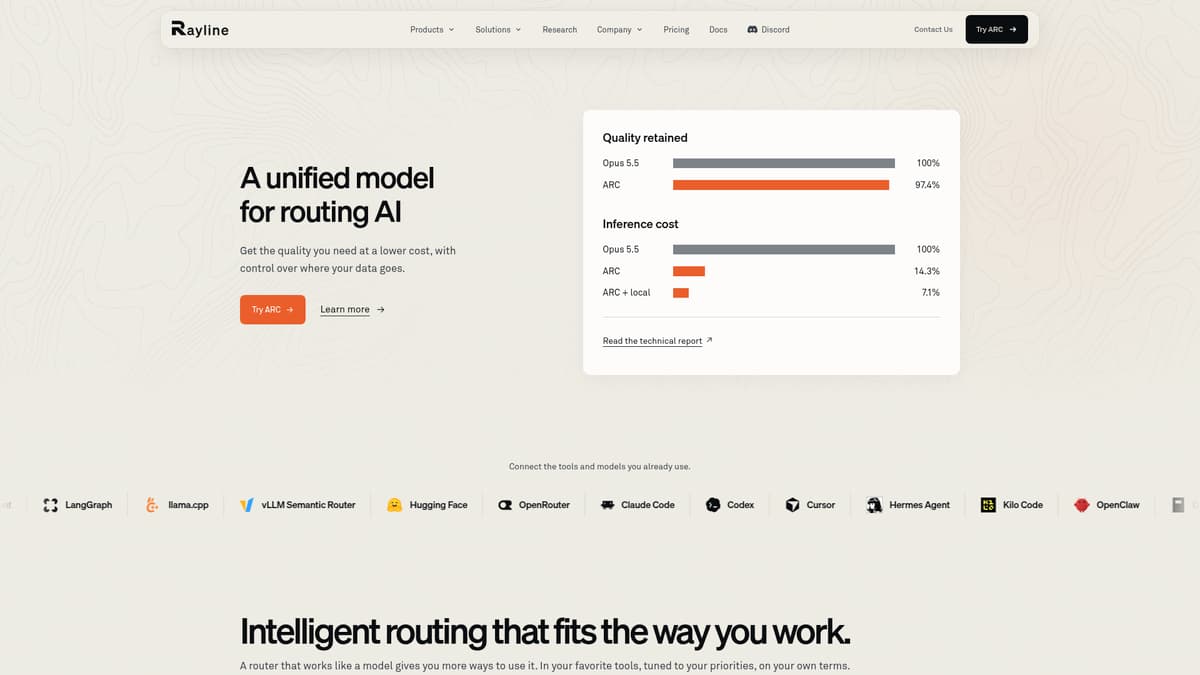
ARC by Rayline is a model routing intelligence platform designed to optimize how AI workflows execute across different compute environments. It works by dynamically selecting which model and reasoning configuration should run each task turn, aiming to strike a balance between response quality, inference cost, latency, and compliance. Businesses can use ARC directly through hosted APIs or incorporate it into their own infrastructure. The tool solves the problem of over-reliance on a single, often high-cost model—ensuring companies deploy the right model for each job rather than one overpowered option for everything.
Key Features
Adaptive routing: ARC evaluates tasks across dimensions like cached context, available compute, cost, and workload to choose between frontier cloud models, open-weight, or on-device compute options. It may stay with a chosen model across multiple turns when that makes sense.
Dual API modes: It offers two main API paths—Decisions and Responses. Decisions returns routing instructions, including which model and reasoning level to use, leaving inference to your systems. Responses handles both routing and generation in one call.
Open-weight and on-device support: ARC supports local model inference and cloud providers via its open-source CLI and gateway infrastructure. Businesses can control where data is processed, on premises or in the cloud, supporting privacy or latency policies.
Cost-quality tradeoff: In benchmarks, ARC retained approximately 97.4 to 97.5 percent of the quality of a high-end model called Opus 5.5 at only 7 to 14 percent of the inference cost, depending on whether it was running in hybrid cloud and local setups.
Agent Gateway and CLI tools: Rayline offers a hosted gateway and a local version to connect agents and applications to models under custom routing policies. The CLI is open source under Apache-2.0; there is no software fee, only hardware and cloud usage costs.
Open source and upcoming releases: The ARC router model weights will be released openly. There are integrations with Hugging Face, semantic routers, and on-device runtimes. Users can define their routing policies and priorities.
Pricing
Rayline publishes proposed token-based rates currently under private preview. For the ARC Decisions API, input tokens that are uncached cost about $0.139 per million tokens; cached reads are billed at about $0.0139 per million. With ARC Responses, uncached input runs about $1.8482 per million tokens, cache reads about $0.195, and output tokens at around $9.2525. Model inference costs are billed separately depending on the provider for Decisions; Responses includes generation handled by Rayline. The Agent Gateway has no additional commission; you pay only for model inference. Plans or fixed-price tiers are not yet publicly listed.
Who is it for?
ARC by Rayline is suited for businesses that run AI-powered agents, applications, or tools across varied workloads and want to optimize for both cost and performance. For example:
Enterprises developing conversational agents, summarization tools, or complex multistep workflows where different task stages have different demands, such as planning, summarizing, or coding.
Companies operating in regulated sectors or with strict compliance and privacy requirements and therefore need control over where computation happens, whether in the cloud or on-device.
R&D or AI infrastructure teams who already use multiple models or providers, or host their own compute, and want to route intelligently rather than manually selecting models for tasks.
Organizations with tight AI spend budgets or who want to control inference costs without sacrificing much in outcome quality.
Final thoughts
ARC by Rayline introduces a thoughtful orchestration layer for the increasingly crowded world of AI models and compute types. It offers a powerful decision engine to optimize for cost, quality, and policy constraints, with flexibility across on-device, open-weight, and cloud models. For businesses grappling with high-volume or varied AI workloads, ARC can deliver significant savings while preserving nearly full performance. If your operations depend on AI and you want smarter, more efficient model usage, ARC is worth considering and carefully testing within your stack.
Visit the official website for more.
Keep up to date with our stories on LinkedIn, Twitter, Facebook and Instagram.