Dynamic Business Logo

Credit: Mark Nolan photography

LinkedIn’s new research on AI at work has good news and a warning for small businesses

LinkedIn’s new research and book on AI reveal the practical gap small business owners need to close right now.

The conversation around AI at work has often been framed as a binary: either you are threatened by it or you are embracing it. New research from LinkedIn suggests the reality is more complicated, and more useful, than that.

A LinkedIn poll conducted alongside the Australian launch of Open to Work: How to Get Ahead in the Age of AI found that when asked how they feel when AI takes over tasks they used to do at work, 42% of Australian professionals say they feel relieved because it frees them up, and 36% say they are curious about what comes next. Only 17% say they feel threatened.

That is a striking result. The dominant emotional response to AI taking work off people’s plates is not anxiety. It is relief.

Matt Tindale, Managing Director of LinkedIn Australia and New Zealand, said the data reflects a readiness that many Australians may not recognise in themselves. “The data tells us that Australians are more ready to adapt than they might think. A new LinkedIn poll found that 78% of Australians feel either relieved or curious when AI takes on tasks they used to do at work, and that openness is exactly the mindset that gets people ahead.”

But relief and curiosity about AI are different from knowing how to use it well. And that is where the more challenging numbers sit.

The skills shift already underway

More than a third of Australian professionals, 37%, say they feel overwhelmed by how quickly they are expected to understand and use AI at work. Nearly two thirds, 63%, believe those who resist AI tools risk falling behind. The gap between those two positions is where most small business owners and their staff currently live.

The pace of the shift in the broader economy makes that gap more urgent. LinkedIn’s research shows hiring for AI talent has grown more than 300% over the past nine years, creating 1.3 million new roles globally. Eight in ten C-suite leaders now say they prioritise hiring someone with AI confidence over experience alone.

In Australia specifically, AI and data skills now make up the largest share of the country’s fastest-growing skills in 2026, according to LinkedIn’s Skills on the Rise data. Prompt engineering has emerged as a sought-after capability, and AI literacy across Australian workplaces has grown 32% year-on-year across firms and 60% in large enterprises.

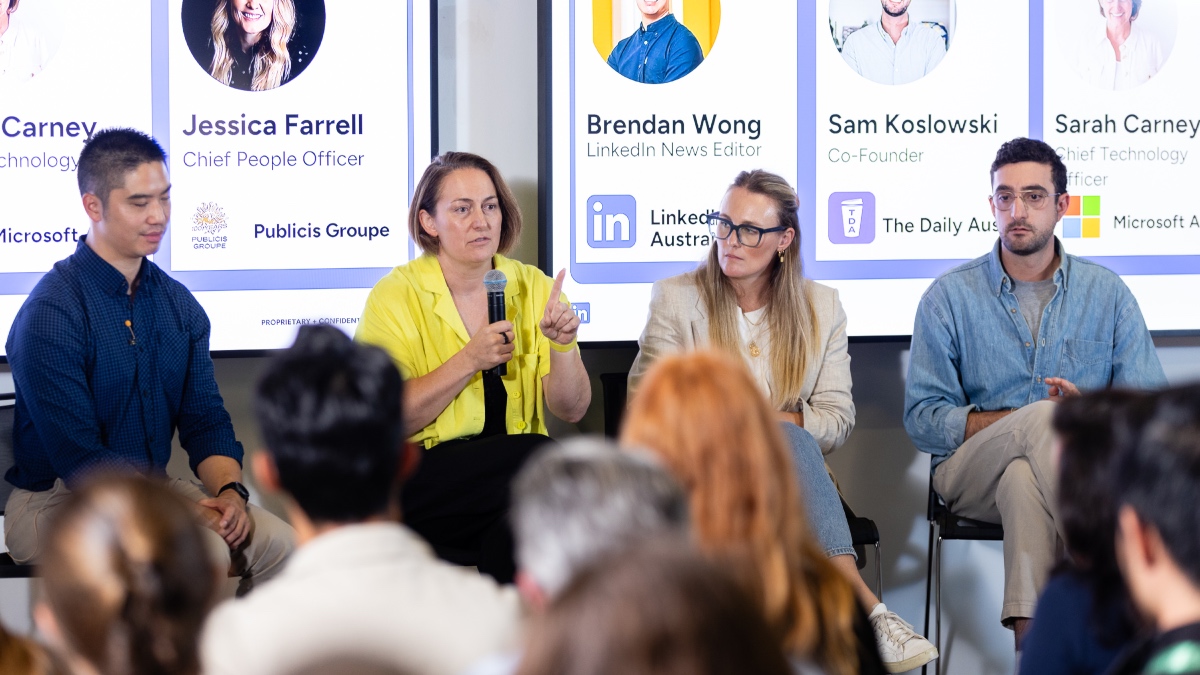
Sarah Carney, National CTO at Microsoft Australia and New Zealand, said the most important step for people feeling behind is simply to start. “The most important step is to start small, stay curious, and practice, because confidence comes from doing. When you pair AI literacy with human strengths like judgement, communication and creativity, it becomes a real advantage in your day-to-day work and your career.”

Human judgement is not going anywhere

One of the more reassuring findings in the LinkedIn data is the strength of trust in human judgement even as AI becomes more embedded in daily work. Eighty-two per cent of Australian professionals say trusted human insight is irreplaceable, even as AI becomes more advanced.

That finding aligns with what the book’s authors argue. Open to Work, written by LinkedIn CEO Ryan Roslansky and Chief Economic Opportunity Officer Aneesh Raman, is drawn from insights across more than a billion LinkedIn members alongside Microsoft research. Its central argument is that the skills no machine can replicate, creativity, curiosity and communication, are exactly the ones that will define career success in an AI-augmented workplace.

Tindale put it directly. Open to Work is “focusing on the creativity, curiosity and communication that no machine can replicate.”

For small business owners, that framing is practically useful. The conversation about AI in the workplace does not need to be about replacement. It can be about reallocation, moving human attention toward the work that genuinely requires human judgement while letting AI handle the tasks that do not.

What this means for small business owners

The LinkedIn data lands at an important moment for small businesses navigating AI adoption. The emotional readiness is there. The skills gap is real. And the pace of change is making both more urgent simultaneously.

Ninety per cent of Chief People Officers in Australia expect work to be organised around skills rather than traditional job titles as roles continue to evolve, according to LinkedIn’s research. For small business owners, that signals a shift in how to think about hiring, training and team structure going forward.

The practical implication is not to overhaul everything at once. Carney’s advice to start small and stay curious applies as much to a small business owner introducing AI tools to a team of five as it does to a corporate executive managing hundreds of staff.

The overwhelm that 37% of Australian professionals report is real. But so is the relief that 42% feel when AI takes tasks off their hands. For small business owners willing to start somewhere, the data suggests the experience of actually using AI well tends to shift people from the first group into the second.

Open to Work: How to Get Ahead in the Age of AI is now available in Australia via major retailers and online platforms.

Yajush Gupta

Yajush Gupta

Yajush writes for Dynamic Business and previously covered business news at Reuters.

View all posts