


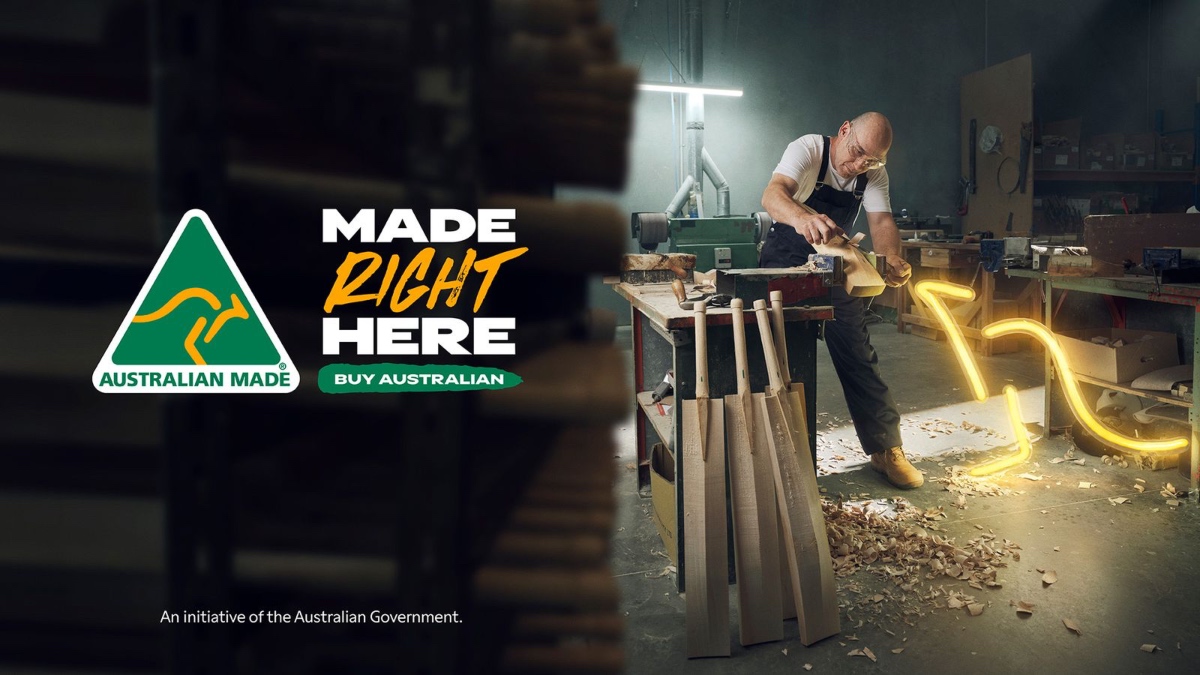


Trust the kangaroo logo. Back local jobs. Strengthen Australian supply chains. That’s the message behind the government’s biggest ‘buy local’ campaign yet.
What’s happening: The Albanese Government has launched its $20 million ‘Made Right Here’ campaign, a flagship election commitment aimed at boosting consumer awareness and purchasing of Australian-made products.
Why this matters: government is betting that better visibility of the Australian Made logo, already recognised by 99% of consumers and licensed by 4,500 businesses, can convert stated consumer loyalty into real purchasing behaviour that strengthens local jobs, supply chains, and industrial capacity.
The economic case is simple and stark. If every Australian household spent just $10 more per week buying Australian-made products, it would generate $5 billion in economic activity and create 10,000 jobs.
That calculation sits at the heart of the Albanese Government’s most ambitious manufacturing push yet. On 23 January 2026, the government officially launched its $20 million ‘Made Right Here’ campaign. It’s a flagship election commitment designed to make the iconic green-and-gold Australian Made kangaroo logo the default choice when Australians reach for products at checkout.
The campaign runs nationally until 30 June 2026 across television, radio, print, out-of-home advertising, digital and social media. It’s the largest awareness push the Australian Made Campaign Ltd has ever mounted.
The campaign launch took place at Capral Aluminium’s sprawling Smithfield facility in southwestern Sydney. It’s one of the southern hemisphere’s biggest industrial precincts and home to thousands of manufacturing workers. It was a deliberate choice of venue, signalling where the government’s priorities lie.
“Launching Made Right Here in my home suburb of Smithfield makes sense. It’s one of the biggest industrial precincts in the southern hemisphere, and it’s where local workers make the products Australians rely on every day,” said Chris Bowen MP, Minister for Climate Change and Energy and Member for McMahon.
“This campaign is about turning national pride into practical support and making it easier for people to back Australian jobs at the checkout. When you choose Australian made, you are backing local businesses, stronger supply chains, and good secure work in communities like ours.
“The Albanese Government is backing Australian manufacturing with a Future Made in Australia, because we want more things made right here, not shipped in from overseas.”
The trust is there, now for the hard part
The foundation for the campaign is rock solid. The Australian Made logo is recognised by 99% of Australian consumers. Trust in the brand sits at 93%, among the highest of any brand tracked by Roy Morgan Research. When asked, 87% of Australians say it’s important to buy Australian-made, and 79% claim they’re willing to pay a premium for locally made goods.
“The Australian Made logo turns 40 this year. In that time, the green-and-gold kangaroo has helped Australians make confident, informed purchasing decisions that support the country’s makers and growers and in turn, local families and communities,” said Kate Carnell AO, Chair of Australian Made Campaign Ltd.
“Today, it remains the most trusted country-of-origin symbol, with 93 per cent of Australians trusting the brand.”
Ben Lazzaro, Chief Executive of Australian Made Campaign Ltd, said the campaign highlights the breadth of Australian-made options across nearly every product category and encourages people to make the right choice and buy Australian where they can.
“Australian Made means made right here in Australia, but the green-and-gold logo means more than just where something is made,” Lazzaro said. “When you choose it, you’re backing local businesses and home-grown ideas as well as supporting fellow Aussies.
“The new campaign also highlights and celebrates what we can often take for granted, which is that we have access to such a wide variety of locally made, high-quality products that play pivotal roles in our everyday lives.”
Those numbers suggest the campaign should work almost by default. Australians trust the logo. They say they want to buy local. The problem is what happens next.
“The Albanese Labor Government backs Aussie made products and shares with the Australian Made Campaign a vision for an Aussie-made future,” said Tim Ayres, Minister for Industry and Innovation and Minister for Science.
“We know that Australians want to back local businesses at the checkout, and this campaign is about making it easier to do that in store and online. We know that if Aussie households spent an extra $10 a week on Australian-made products, it would boost our economy by $5 billion and create 10,000 jobs.
“If you look for and choose the iconic kangaroo logo when you do your shopping, you’re supporting local jobs and investing back into the local economy. Buy proudly Australian this long weekend.”
But stated intentions and actual purchasing behaviour often diverge sharply, particularly when household budgets are under strain. Seventy-four per cent of Australians identify rising living costs as a major concern. Fifty-seven per cent have permanently switched to store-brand products. Another 15% plan to. Nine in ten are worried about grocery prices.
The real test isn’t whether Australians recognise or trust the kangaroo logo. It’s whether that trust translates into spending when a local product costs more than an imported alternative.
Manufacturing under siege
For manufacturers like Capral Aluminium, the stakes couldn’t be higher. The company has operated on Australian soil for 90 years, operating across six locations nationally including its Smithfield headquarters. It’s one of 4,500 businesses licensed to use the Australian Made logo. Companies like this see their sales directly support thousands of manufacturing jobs.
“Capral Aluminium has operated in Australia for 90 years because we believe local manufacturing adds value to the Australian economy,” said Tony Dragicevich, Managing Director and CEO of Capral Aluminium. “Capral is immensely proud to be an Australian Made licensee. Australian Made, including the Made Right Here campaign launched today, gives manufacturers like Capral a trusted, universally recognised mark that helps identify Australian-made products and gives customers confidence that they are buying quality.
“By backing Australian jobs, skills and investment, the campaign strengthens our industry today and into the future.”
Yet the sector faces relentless pressure. Operating margins in Australian manufacturing fell from 8.8 per cent to 7.9 per cent in the 2022-23 financial year, with nine of thirteen subindustries reporting declines. Wage rates have surged 11.5 per cent over the past three years, the highest increase of any industry in Australia.
Energy costs have been particularly brutal. Natural gas prices, which underpin much of Australian manufacturing, have risen 58 per cent. That’s before factoring in steel, aluminium, and labour.
The result is an industry bleeding margin whilst facing the worst worker shortage in decades. There are presently 17,000 unfilled jobs in manufacturing, up from 11,000 before the pandemic, with 63 per cent of recruiting manufacturers reporting difficulties filling advertised roles.
But strengthening is only possible if customers actually choose the local option when they see it.
The government’s wager
The Albanese Government framed the ‘Made Right Here’ campaign as delivering on a core election promise: backing Australian manufacturing and rebuilding industrial capacity under its ‘Future Made in Australia’ policy framework.
“If you look for and choose the iconic kangaroo logo when you do your shopping, you’re supporting local jobs and investing back into the local economy,” Ayres said.
The $20 million investment is real, but it’s relatively modest given the scale of the challenge. The campaign’s success will depend on whether reminding Australians of their own stated values can overcome immediate financial pressures.
Younger consumers present a particular puzzle. Gen Z and Millennials embrace sustainability and corporate values as purchase criteria. They care about where things are made and who makes them. Yet they’re also the most price-sensitive cohort, with affordability increasingly overriding other considerations as cost-of-living pressures bite.
The broader consumer picture is equally mixed. Eighty per cent of Australians now actively stock up on products when they’re on sale. Seventy-one per cent will make unplanned purchases after spotting discounted items. Fifty-six per cent prioritise value above all other factors when deciding whether to change brands or stores.
Patriotism and ethics, in other words, are becoming luxuries most households simply cannot afford.
The real measure
For the campaign to succeed, one of three things needs to happen. Either manufacturing costs fall dramatically, which is unlikely given energy and labour pressures. Or household budgets ease, reducing the immediate financial desperation that drives switching to store brands. Or the campaign’s messaging proves powerful enough to shift behaviour despite those headwinds.
The government’s economic argument, that $10 weekly translates to $5 billion and 10,000 jobs, is sound. The question is whether that macro-level reasoning resonates when a family is standing at the checkout deciding between a $15 Australian-made product and a $12 import.
The campaign runs until 30 June 2026. The real verdict won’t come from brand recognition or trust metrics. It will come from till rolls and manufacturing floor activity. If Australian-made sales lift noticeably, the $20 million will have paid for itself many times over. If they don’t, it will be a sobering reminder that good intentions matter far less than household budgets when Australians shop.
For manufacturers like Capral, for the 4,500 businesses carrying the kangaroo logo, and for the 17,000 unfilled jobs in the sector, the next six months are critical. The campaign has launched. Now comes the hard part: converting trust into tills.
Keep up to date with our stories on LinkedIn, Twitter, Facebook and Instagram.
