Dynamic Business Logo

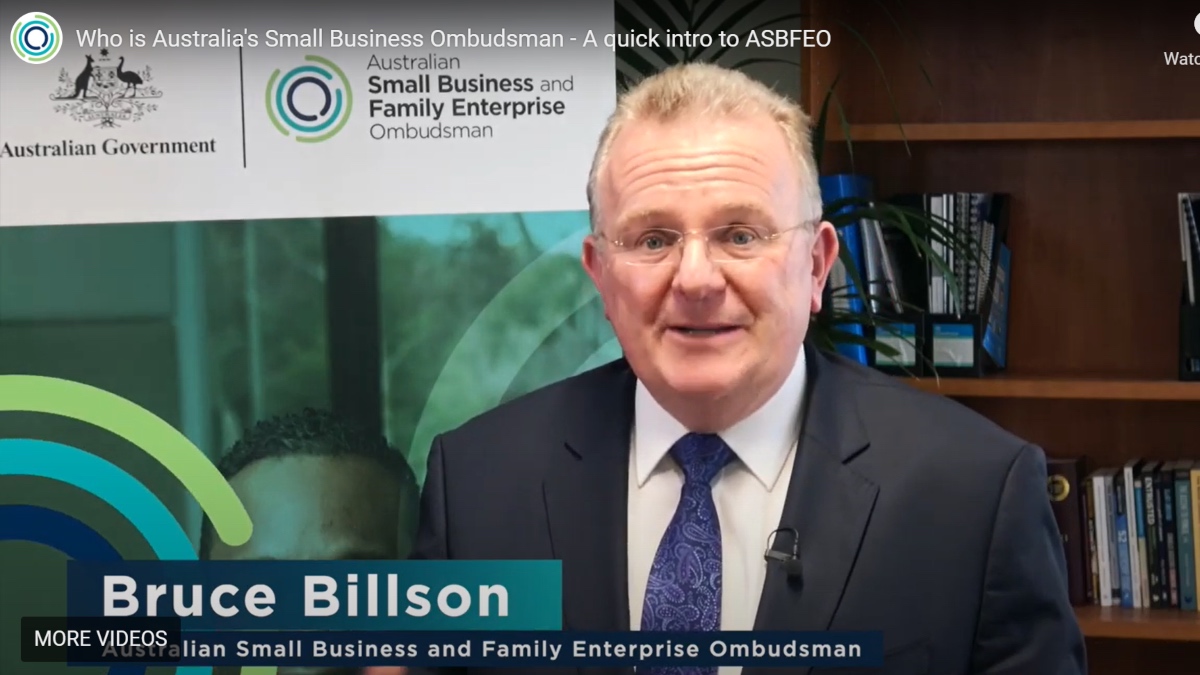
ASBFEO’s Bruce Billson. Image vi YouTube

A decade of backing small business: ASBFEO marks ten years as Bruce Billson bids farewell

Bruce Billson is stepping down as small business ombudsman after a decade of advocacy.

What’s happening: The Australian Small Business and Family Enterprise Ombudsman is marking ten years of operation on 11 March 2026. The milestone coincides with Bruce Billson concluding his tenure as Ombudsman.

Why this matters: For small business owners who have navigated disputes, late payments, regulatory pressure or economic shocks over the past decade, ASBFEO has been a practical backstop that most large businesses take for granted. As it enters its second decade, Billson says the work is far from done.

When Bruce Billson helped establish the Australian Small Business and Family Enterprise Ombudsman a decade ago, the goal was straightforward: give small and family businesses a strong, independent voice and practical support when the system was working against them.

Ten years and more than 60,000 requests for help later, the office he created is marking its anniversary. And as Billson concludes his tenure as Ombudsman, he says the mission remains unfinished.

Built to level the playing field

ASBFEO was established under the Australian Small Business and Family Enterprise Ombudsman Act 2015, with operations commencing in 2016. Billson, who was instrumental in creating the office during his time as Minister for Small Business between 2013 and 2015, says the power imbalance he witnessed firsthand was the driving force behind its creation.

“I saw first-hand the power imbalance faced by small and family businesses when dealing with larger businesses and corporations, banks and creditors and even government agencies,” Billson said. “These enterprising women and men are resilient and hardworking, but they’re too often dealing with frameworks that don’t reflect real world business operations. ASBFEO was established to change that, to be an advocate and ally, and a practical problem solver.”

Over the decade since, the office has grown into what Billson describes as a respected organisation, widely recognised by the small and family business community, industry bodies, regulators, major corporates, parliamentary committees and government.

Sixty thousand requests for help

The practical impact of ASBFEO’s assistance function is most visible in the individual cases it has resolved. The office provides direct help with payment, contract, franchise, digital platform and other commercial disputes, and has expanded over the years to include low-cost legal support through the Small Business Tax Concierge and subsidised legal advice for unrepresented small businesses.

One case Billson singles out illustrates the stakes involved for many of the businesses that come through the door. A small business that had defaulted on a loan with a lender outside the Australian Financial Complaints Authority was facing exorbitant late penalty fees and had its family home on the line. Following ASBFEO’s correspondence, the lender removed the penalty fees.

“That outcome mattered, and there are thousands more like it,” Billson said. “These cases are a reminder just how easily small business can be disproportionately burdened and come under harm. The reality is, small business owners are not well resourced, often time-poor and wear multiple hats just to keep the business viable.”

Advocacy that moved the needle

Beyond individual cases, ASBFEO has consistently pushed for structural reform, calling for regulation that is proportionate, risk-based and workable in the real world. Billson is direct about why that advocacy matters.

“Too often, small businesses are not in the room when policy decisions are made, yet they are the first to feel the impact when those decisions land,” he said. “Rules are written by people who don’t run payroll on a Friday night, who don’t carry personal guarantees, and who don’t absorb the risk when cash flow dries up.”

The office has also turned its attention in recent years to what Billson calls white tape, the administrative and compliance costs quietly accumulating in business-to-business relationships, and has advocated for a small business first mindset to be applied to every new policy proposal.

ASBFEO’s policy and advocacy work has spanned regulatory reform, tax and investment settings, workforce access and simpler, faster and lower-cost access to justice. Its Small Business Pulse has provided timely data on trading conditions, digital and AI adoption, workforce challenges and emerging pressures.

“Our advocacy has urged practical support and meaningful incentives to support small businesses deepening their digital engagement and benefit from new technologies, including AI,” Billson said.

As he steps down, Billson is clear-eyed about what remains to be done. Small businesses, he argues, are not a single uniform group. They span industries, regions, business models and life stages, with different views, priorities and pressures. That diversity makes them harder to represent through traditional policy processes, which is precisely why ASBFEO exists.

“Small and family businesses are resilient, innovative and essential to Australia’s economy, but they should not have to succeed despite the system,” Billson said. “They should be able to operate in a small business ecosystem that enables their success.”

His closing message to the office he helped build is both a reflection and a directive. “As ASBFEO enters its next decade, the mission is clear. Keep backing small and family business, keep pushing for fairness, and keep making sure enterprising women and men’s voices, in all their diversity, are heard in the rooms where decisions are made, and reflected in the outcomes that follow.”

Yajush Gupta

Yajush Gupta

Yajush writes for Dynamic Business and previously covered business news at Reuters.

View all posts