


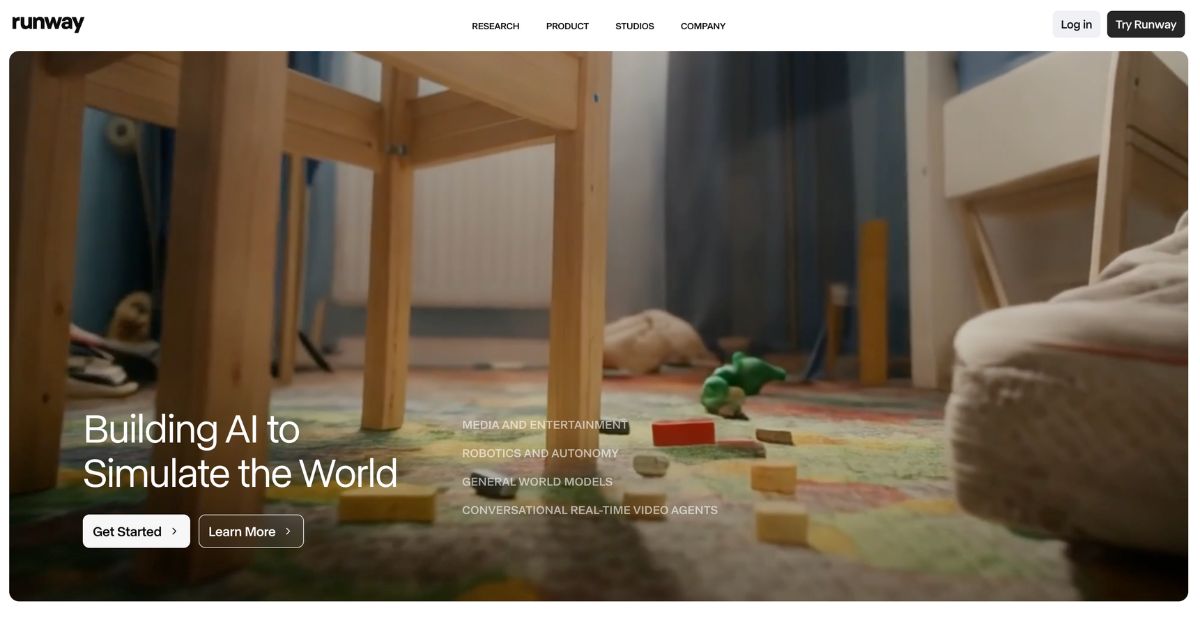


Runway has successfully transitioned from a “creative tool” for video editors to a “World Simulation” company building the physics engine of the future. While it initially gained fame for the Gen-2 and Gen-3 Alpha video generation models, 2026 sees the company doubling down on General World Models (GWM). Unlike standard video generators that simply predict the next pixel, Runway’s GWM-1 (released in late 2025) understands the underlying physics, lighting, and object permanence of a scene, allowing it to simulate entire interactive environments rather than just passive clips.
The company’s “killer app” for the film industry remains Act-One, a breakthrough tool that allows a single actor to control the performance of a generated character using simple video input—capturing nuanced facial expressions without expensive motion capture suits. Despite early friction in its high-profile partnership with Lionsgate, Runway has become the de facto “AI VFX” department for Hollywood, enabling directors to generate background plates, style-transfer entire scenes, and animate characters at a fraction of the traditional cost.
Read more: The 34 most promising US startups of 2026
Core Technology: General World Models & Act-One
- General World Model (GWM-1): A simulation engine that models physical laws, allowing for consistent environments that don’t “morph” or hallucinate when the camera moves. It powers three verticals: GWM-Worlds (interactive environments), GWM-Robotics (synthetic data for robot training), and GWM-Avatars.
- Act-One: A performance transfer tool that uses a simple “driving video” (e.g., a user making a face into a webcam) to control the emotional expression and movement of an AI-generated character with high fidelity.
- Gen-3 Alpha: The flagship video generation model known for its photorealism and precise temporal control, now integrated directly into the Runway Studios production workflow.
Business & Market Status
- Valuation: Valued at over $3 Billion following a $308 Million Series D round in April 2025 led by General Atlantic.
- Hollywood Integration: While the Lionsgate partnership (announced late 2024) faced hurdles regarding library access and rights, it established Runway as the first AI model trained specifically on a major studio’s proprietary catalog.
- Enterprise Expansion: Beyond media, Runway is aggressively selling GWM-Robotics to manufacturing and logistics firms, using its world models to train autonomous robots in safe, simulated environments.
Company Profile
- Founders: Cristóbal Valenzuela (CEO), Alejandro Matamala, and Anastasis Germanidis.
- Headquarters: New York, New York.
- Funding: Raised over $540 Million total.
- Key Investors: General Atlantic, Google, NVIDIA, Salesforce Ventures, Coatue, Felicis.
Key Use Cases
| Use Case | Description |
|---|---|
| Virtual Production | Directors use GWM-1 to generate interactive, 3D-consistent backgrounds for LED volumes, replacing expensive on-location shoots. |
| Character Animation | Animators use Act-One to record their own facial performances and instantly apply them to alien, cartoon, or photorealistic characters. |
| Robotics Training | Engineers use Runway’s physics simulators to “teach” robots how to navigate complex environments (like warehouses) before deploying them in the real world. |
Why It Matters
Runway is proving that “Video” is just data for a much larger goal: simulating reality. By building models that understand how the world moves and reacts—rather than just what it looks like—they are bridging the gap between filmmaking, video games, and robotics. They are arguably the most important “Simulated Reality” company in the world.
