


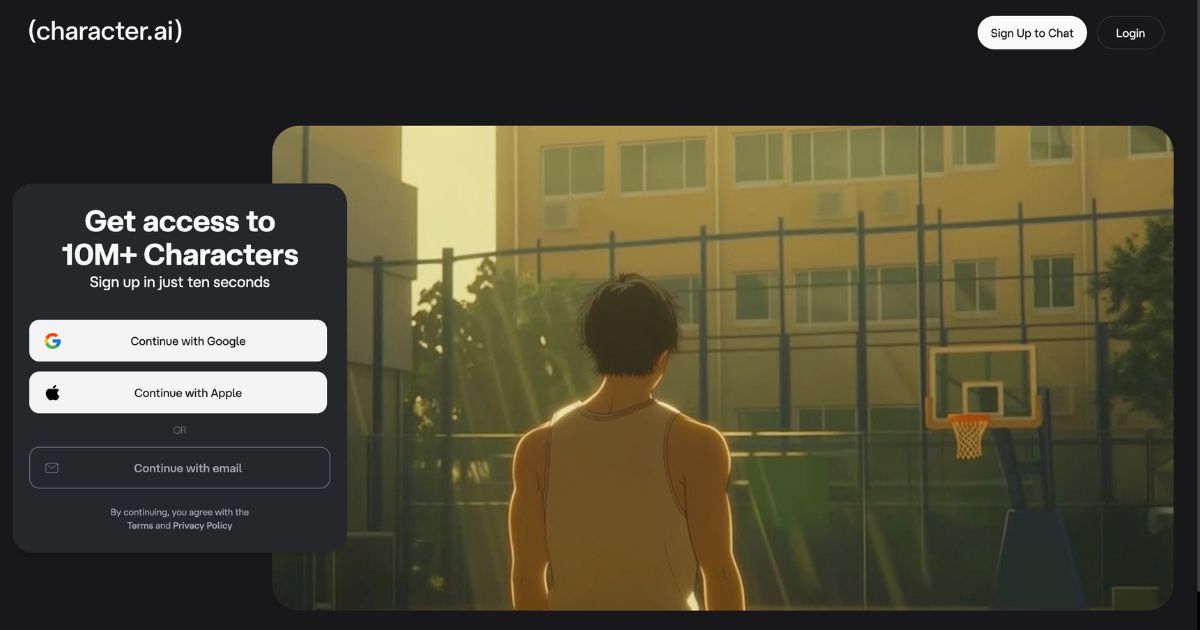


Character.ai has established itself as the world’s leading platform for “Agentic Companionship,” fundamentally changing how humans interact with artificial intelligence. While other labs focus on productivity or coding, Character.ai focuses on personality. Its platform allows millions of users to create and converse with distinct AI “characters”—from historical figures and fictional heroes to language tutors and psychologists—that feel uniquely alive. By 2026, the company has successfully pivoted from a simple text chat interface to a multimodal “Personalized Superintelligence,” introducing features like Character Calls, which allow users to have seamless, two-way voice conversations with their AI companions that sound indistinguishable from a real phone call.
The company’s trajectory changed dramatically in late 2025 following a high-profile “acqui-hire” deal with Google. While founders Noam Shazeer and Daniel De Freitas returned to Google DeepMind, Character.ai remains an independent operating entity, now leveraging a hybrid model architecture that combines its own proprietary fine-tuning with Google’s massive compute resources. This partnership has allowed it to deploy advanced features like “PipSqueak,” a tighter, less “hallucinogenic” model that powers its new “Stories” mode—a visual, choose-your-own-adventure experience that has become a hit with younger demographics.
Read more: The 34 most promising US startups of 2026
Core Technology: Conversational Texture & Voice
- Proprietary Conversational Models: Unlike generic LLMs designed for factual accuracy, Character.ai’s models are optimized for “emotional texture,” empathy, and roleplay consistency.
- Character Calls: A real-time, low-latency voice engine that allows two-way spoken conversation. It handles interruptions naturally (users can “barge in” while the AI is talking) and includes emotional inflection.
- Auto-Memory: A long-term context system that automatically summarizes and stores key details from past conversations, ensuring your companion remembers your name and history weeks later.
- Stories Mode: A gamified, visual interface where the AI acts as a “Dungeon Master,” generating images and plot points that users navigate through choices rather than just typing text.
Business & Market Status
- Valuation: Valued at approximately $1 Billion following the strategic restructuring with Google (after previously targeting a $5B valuation).
- User Base: Commands a massive, highly engaged audience of over 20 million monthly active users, with an average daily engagement time of over 2 hours—metrics that rival top social media apps like TikTok.
- Google Partnership: Secured a $2.7 Billion licensing deal with Google in late 2025, which provided the capital to sustain its massive inference costs while transferring its founders back to the search giant.
Company Profile
- Founders: Noam Shazeer and Daniel De Freitas (original founders, now at Google). Current leadership includes Dominic Perella (Interim CEO).
- Headquarters: Menlo Park, California.
- Funding: Raised over $193 Million (excluding the Google licensing revenue).
- Key Investors: Andreessen Horowitz (a16z), SV Angel, A.Capital Ventures.
Key Use Cases
| Use Case | Description |
|---|---|
| Language Learning | Users practice speaking new languages with patient, always-available AI tutors that can correct pronunciation over voice calls. |
| Creative Writing | Authors and gamers use the platform to “interview” their own characters, fleshing out backstories and testing dialogue in real-time. |
| Companionship | Millions of users utilize characters for social interaction, emotional venting, and roleplay, reducing feelings of loneliness. |
Why It Matters
Character.ai proved that “utility” isn’t the only killer app for AI—”connection” is just as powerful. It was the first company to demonstrate that people would spend hours a day talking to a machine, provided that machine had a personality. As the industry shifts toward “Agentic” systems that act on our behalf, Character.ai is building the “Social Layer,” ensuring that our future digital assistants aren’t just smart, but also empathetic, funny, and uniquely human.
