


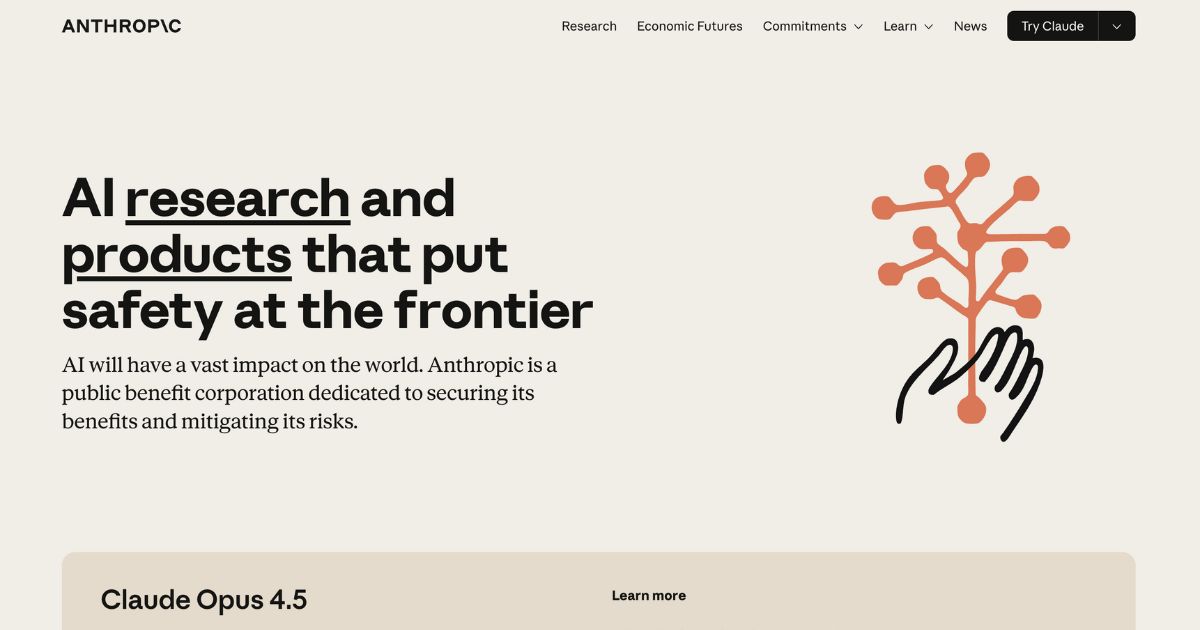


Anthropic has evolved from a safety-focused research lab into the default “operating system” for the next generation of software development. While the company is famous for its Claude family of foundation models—including the industry-leading Claude Opus 4.5 released in late 2025—its defining product in 2026 is Claude Code. This agentic Command Line Interface (CLI) tool allows developers to give Claude direct access to their terminal and codebase, enabling the AI to autonomously plan, write, test, and debug complex features without constant human hand-holding.
The company’s competitive edge lies in its mastery of “Computer Use“—the capability for its models to view a screen, move a cursor, and interact with software interfaces exactly like a human. This transforms Claude from a passive chatbot into an active employee capable of executing multi-step workflows. Despite this aggressive push into autonomous agents, Anthropic maintains its “Constitutional AI” safety framework, positioning itself as the responsible choice for enterprises that need powerful AI workers that adhere to strict safety and alignment protocols. With the recent launch of its Labs division (led by Instagram co-founder Mike Krieger), Anthropic continues to experiment with novel interfaces that move beyond the text box.
Read more: The 34 most promising US startups of 2026
Core Technology: Agentic Coding & Constitutional AI
- Claude Code (CLI): A developer-native tool that lives in the terminal, capable of navigating file systems, running tests, and executing multi-step coding tasks autonomously.
- Computer Use: The ability for models to view a screen, move a cursor, and interact with software interfaces exactly like a human, transforming Claude from a passive chatbot into an active employee.
- Constitutional AI: A unique training method where models are trained to follow a set of high-level principles (a “constitution”), reducing the need for extensive human labeling and ensuring safer outputs.
- Artifacts: A dedicated window feature that allows users to generate and iterate on code, documents, and diagrams side-by-side with the chat.
Business & Market Status
Valuation: Valued at approximately $183 Billion following a massive $13 Billion Series F round in September 2025 (with reports in Jan 2026 of a new raise targeting $350 Billion).
Enterprise Traction: Widely adopted by the Fortune 500 for internal knowledge synthesis and coding assistance, positioning it as the primary rival to OpenAI in the corporate sector.
Labs Division: Launched in 2025 under Mike Krieger to build novel user interfaces beyond the chat box.
Company Profile
Founders: Dario Amodei (CEO) and Daniela Amodei (President) – former VP of Research and VP of Safety at OpenAI.
Headquarters: San Francisco, California.
Funding: Raised over $27 Billion total.
Key Investors: Amazon, Google, ICONIQ Capital, Lightspeed Venture Partners, Salesforce Ventures.
Key Use Cases
| Use Case | Description |
|---|---|
| Autonomous Coding | Developers use Claude Code to refactor entire codebases, write unit tests, or build features overnight, acting as an “always-on” junior engineer. |
| Legal & Compliance | Law firms and banks utilize Claude’s massive context window to analyze thousands of pages of contracts and regulations without data retention risks. |
| Complex Reasoning | Research labs use Claude Opus for high-level scientific reasoning and hypothesis generation, leveraging its low hallucination rates. |
Why It Matters
As AI models hit a plateau in raw text generation, the frontier has shifted to “Agency”—the ability for AI to do work, not just talk about it. Anthropic is leading this shift by giving its models direct access to developer tools. By proving that AI can safely execute complex, multi-step workflows like coding and research, Anthropic is building the infrastructure for the “AI Workforce” of the future.
