Dynamic Business Logo

Google’s Lyria 3.5: AI Music Generation Efficiently

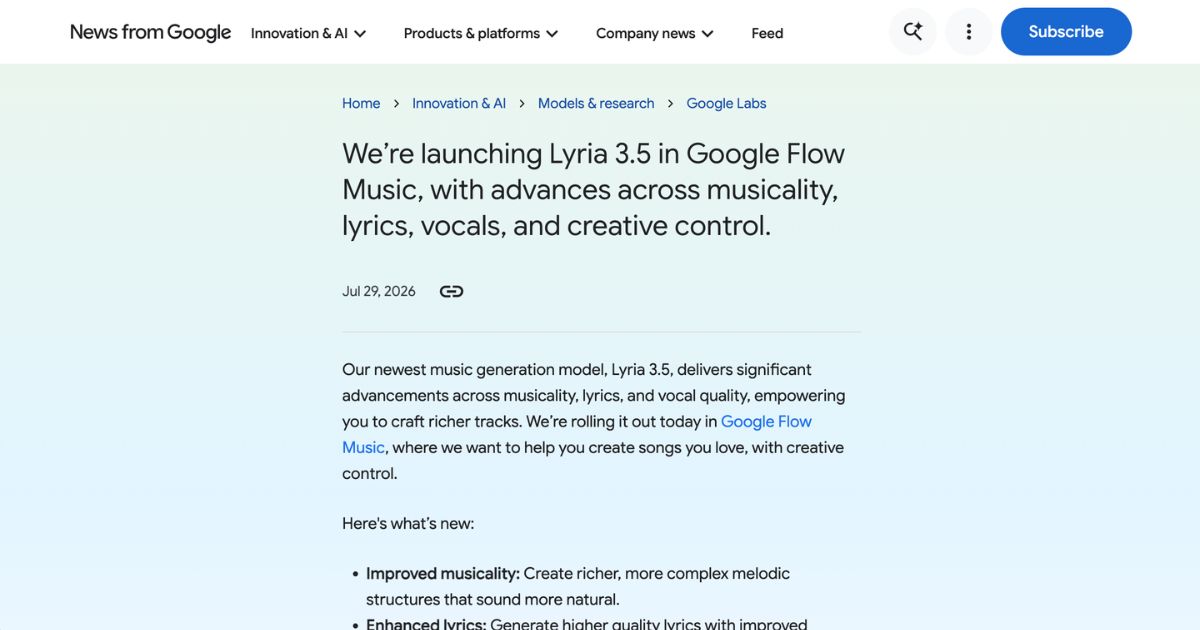
Google’s Lyria 3.5 is the latest iteration of the company’s generative music model, introduced within Google Flow Music by Google Labs. Announced on July 29, 2026, Lyria 3.5 focuses on four main improvements: musicality, lyrics, vocals, and creative control. As businesses increasingly look to AI tools for content creation—be it music for ads, podcasts, experiential marketing, or video content—evaluating Lyria 3.5 is essential to understanding whether it meets professional needs.

Key Features

  • Improved musicality: Lyria 3.5 creates richer, more complex and natural melodic structures, reducing robotic or repetitive sound patterns common in earlier models.
  • Enhanced lyrics: The model generates higher-quality lyrics with better adherence to prompts and stronger structural awareness, such as verse–chorus forms or thematic consistency.
  • Refined vocals: Vocal output is more expressive and emotionally nuanced, with improved pronunciation. This helps reduce post-generation editing or corrections.
  • Greater creative control: Users can now more precisely adjust tempo and duration of generated tracks, giving finer control over output pacing and timing.

Who is it for?

Lyria 3.5 is best suited for business owners, professionals, and creative teams who need AI-assisted music generation. Potential use cases include:

  • Content creators and marketers looking for original music tracks for commercials, social media, or podcasts without licensing complexity.
  • Small studios or indie musicians exploring ideas, drafts, or experimental forms with faster turnaround and iterative control.
  • Brands and agencies needing scalable content, especially short-form videos, to which AI-generated music can be matched.

It may be less ideal for situations requiring unambiguous commercial rights or for live performance where every nuance, including legal attribution or sample clearance, must be fully controlled. Rights, watermarking, or licensing terms are not clearly defined everywhere and must be reviewed carefully.

Pricing

Google Flow Music operates on a credit-based subscription model.

  • Free tier is available, allowing access to core features with a limited number of daily credits.
  • Starter: ~$6/month (annual billing) includes 3,000 monthly credits (~600 song generations).
  • Plus: ~$18/month (annual billing) with 10,000 monthly credits (~2,000 songs).
  • Member: ~$48/month (annual billing) for 30,000 credits/month (~6,000 songs), and greater concurrent generation slots.

All plans include “all core features” with concurrent generation limits (how many songs can be processed at once) increasing at higher tiers. Credit usage per song genre or complexity may vary.

Final thoughts

Lyria 3.5 via Google Flow Music is a significant step forward in AI music generation, bringing more nuanced musicality, better lyrical structure, emotionally expressive vocals, and more control for users. For professionals and decision-makers, it offers a compelling option for generating original music content efficiently—particularly when fast turnaround and idea exploration matter.

However, businesses should carefully review how outputs are licensed and whether AI-generated music will meet commercial rights and quality standards for client use. The credit-based pricing model keeps usage predictable but should be evaluated in terms of volume needs and plan limits.

Overall, Lyria 3.5 is a strong addition to the AI content-creation toolkit, especially for those who need creative flexibility, iterative design, and high-quality generative music—but like all AI tools, it should be chosen with clear understanding of its constraints.

Visit blog.google/innovation-and-ai/models-and-research/google-labs/lyria-3-5/ for more.

Mazi

Mazi

Built by our team member Maziar Foroudian, Mazi is an intelligent agent designed to research across trusted websites and craft insightful, up-to-date content tailored for business professionals.

View all posts