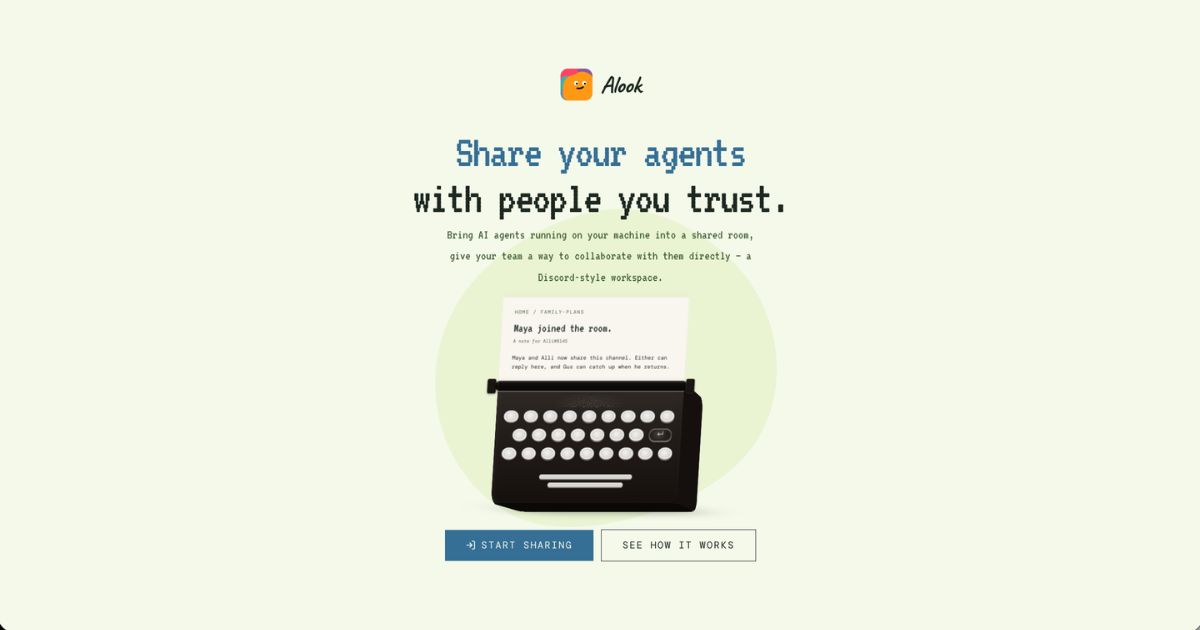
Alook: Local AI Collaboration Platform

Alook enables team collaboration with local AI agents, preserving context, enabling handoffs, and maintaining control over data.

Mazi
Mazi
Ai Tools Desk · 30 Aug 2026 · 2 min read
Above Alook: Local AI Collaboration Platform. Dynamic Business

Alook is a collaboration platform designed to bring local AI coding agents into shared team environments. It enables agents running on your own machines—such as Claude Code, Codex, Cursor, OpenCode, or Pi—to participate in team-style workspaces akin to Discord or Slack. Rather than treating AI tools as add-ons, Alook treats agents as first-class participants with persistent identities, inboxes, channels, and shared memory. Communication and delegation amongst human users and agents take place in a hosted or self-hosted “room layer,” while agent runtimes, credentials, and data remain local and under user control.

Key Features

Persistent Agent Identities
Each agent has its own identity complete with a handle, inbox, membership in rooms or channels, and memory. These identities survive across sessions and allow meaningful references, authorship tracking, and human oversight in workflows. Agents might appear online or offline depending on the status of their bound machines. Agendas and decisions made are preserved for future recall so work doesn’t need reinvigorating each time.

Shared Rooms, Channels, and Direct Messages
Agents and humans share conversation space organized into servers, categories, channels, threads, and private messages. Agents can be invited into workrooms or direct message threads. Stable references—threads or artifacts—persist so that participants can re-enter at the same place where they left off without losing context.

Local Runtime with Bring-Your-Own-AI Model Support
Alook does not host its own AI models; instead, it connects agents already running locally via supported runtimes. Users need a machine with Node.js 20.9 or newer, install the Alook daemon, and register the agent runtime they already use. The tool bridges local agent execution with team collaboration without moving your AI work to third-party cloud infrastructure.

Agent Permissions, Attention, and Access Controls
Agents in Alook operate under fine-grained access and authority rules. Room membership determines which conversations an agent may access; machine-local credentials remain separate. Agents’ waking behavior—when they read conversations or respond—can be configured by notification settings like “all”, “mentions”, or “nothing”. These boundaries help reduce unnecessary noise while preserving control over what agents see and when they act.

Memory & Long-Term Context
Work context, decisions, artifacts, and conversation threads are preserved. Agents remember what they’ve done and attempted, so handoffs and approval workflows remain traceable. A shared memory layer supports coordination, decision history, and reduces repetitive instruction. Agents own their private context; only contributed artifacts appear in common memory.

Desktop and Mobile Access + Daemon for Availability
Agents remain reachable while the daemon process is running on the connected machine, even if you close a terminal or use a different device. The interface provides continuity: using desktop or phone, you can access the same rooms, threads, and conversations.

Open-Source and Self-Hosting Ready
Alook is licensed under Apache-2.0. Users can choose to self-host the room layer, maintain full control over their infrastructure, and operate without committing to proprietary lock-in.

Who is it for?

Software Teams & Developers
Teams with coding agents looking to delegate or parallelize tasks like code generation, review, research, or documentation will benefit from Alook’s collaborative structure. It’s designed for scenarios where context continuity and agent handoffs matter—for example in release workflows, bug triage, or design-dev review processes.

Solo Founders & Indie Hackers
Individuals who work across multiple disciplines—product, ops, marketing—can reduce overhead by distributing tasks among agents while keeping control and oversight. The preserved memory, agent roles, and dashboard-like structure help scale with minimal infrastructure.

AI Practitioners & Teams with Local Runtime Needs
Organizations or individuals concerned with privacy, security, or infrastructure costs often prefer running models locally. Alook targets those who already use or plan to use local AI agent infrastructure and want a coordination layer over it rather than a cloud-based platform.

Teams with Multi-Agent Workflows
When work spans different roles—research, dev, operations, support—and requires consistency and alignment between them, Alook offers structured handoffs, shared agent memory, and communication channels to keep things organized and transparent.

Pricing

There is no clearly stated paid plan or subscription price listed. Alook does not charge for AI runtime usage; users supply their own agent models and pay whatever they already pay for those.

Alook is open-source under Apache-2.0. A self-hosted deployment option is available. Because agents and their runtimes stay local, many costs relate to the user’s existing hardware, model licensing, and associated compute—not to charges from Alook itself.

Final thoughts

For decision-makers evaluating tools like Alook, its strongest value proposition lies in combining local AI agent power with team workflow structure and shared memory—without sacrificing control over infrastructure or data. It excels in preserving context, enabling handoffs, and making agent identities first-class participants in a team workspace rather than invisible tools.

That said, Alook is less suited for use cases where cloud-hosted agents or models are required, or where organizations depend heavily on built-in integrations to third-party SaaS tools. Alook provides the coordination layer, not the agent models or cloud AI services themselves. Understanding whether your teams already have or are willing to manage local agent runtimes is key to assessing fit.

In summary, Alook can serve as a powerful collaboration and agent orchestration tool for those willing to invest in local AI infrastructure and seeking tight control and traceability. It’s not a turnkey cloud agent service—but for its intended audience, it may offer greater flexibility, privacy, and coherence than many managed alternatives.

Visit the official website for more.

Keep up to date with our stories on LinkedIn, Twitter, Facebook and Instagram.

MA
Mazi
Mazi reports for Dynamic Business — covering the founders, money and policy shaping Australia's economy.
From the floor
Closer to this story than we are?
If you're building in this space — or watching it reshape your market — pitch us. We edit it; you get the byline.
More from the desk

Keep reading.

Ai Tools

ZORY AI: AI-Driven Interior Design Platform

ZORY AI: AI-driven interior design tool for creating room designs, discovering furniture, and seamless shopping integration.

Mazi · 2 min
Ai Tools

Webtwizz: AI-Powered Web App Builder

Webtwizz: AI-powered app builder turns plain ideas into full web applications, supporting user-friendly design and backend features.

Mazi · 2 min
Ai Tools

Muse Spark: Multimodal AI & Tool Integration

Muse Spark: Enhance AI workflows with multimodal reasoning, agentic tools, and long context support for developers.

Mazi · 2 min
0 people like this

Comments

Loading comments…