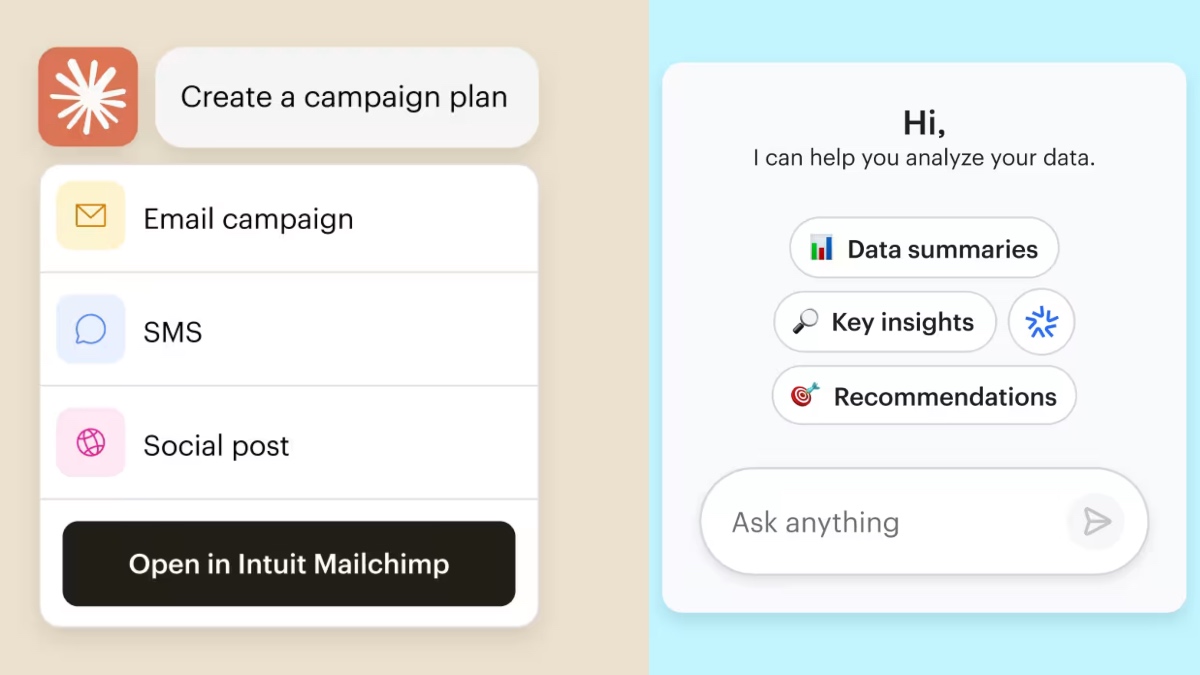
Intuit Mailchimp launched a conversational analytics agent that lets marketers ask plain-language questions about campaign performance and get instant recommendations.
If you use Mailchimp to run email marketing for your business, you have probably spent time doing something that feels like it should be easier: exporting data, building pivot tables, trying to work out why last month’s campaign underperformed, or figuring out which segment of your list is actually driving revenue. Mailchimp’s latest launch is a direct attempt to eliminate that work entirely.
Intuit Mailchimp has launched Analytics AI, a conversational analytics agent built natively into the platform that lets you ask plain-language questions about your campaigns and get immediate answers with strategic recommendations attached. Rather than building dashboards or manually analysing exports, you type a question, and the agent analyses your campaign performance, audience behaviour, and revenue data to tell you what changed, why, and what to do next.
What Analytics AI actually does
The core problem Analytics AI is designed to solve is the gap between having data and knowing what to do with it. Diana Williams, VP of Product at Intuit Mailchimp, describes the situation many small business marketers find themselves in. “Ecommerce brands tell us they have too much data but are starving for actionable insights,” she says. “Analytics AI starts by eliminating the gap between data and decision. Ask a question, get a strategic answer, and act on it instantly.”
In practice, that means being able to ask things like which campaigns drove the most revenue last quarter, which audience segments are most engaged, or why open rates dropped in a particular send, and getting a clear answer rather than a raw data export you then have to interpret yourself. The agent pulls from connected ecommerce data across platforms including Shopify, WooCommerce, and Wix alongside Mailchimp campaign history to identify patterns and surface specific next-step recommendations.
Paulina Petkoski, founder of contemporary art gallery Playground Detroit, was part of the private beta. “Mailchimp’s Analytics AI makes it easy to see what’s working by turning our historical data into something we can act on,” she says. “Instead of spending over an hour manually processing reports, we can instantly access what we need through an intuitive, interactive search to help us make smarter decisions, refine our strategy, and increase subscriber engagement and ecommerce growth.”
The AI Segment Builder, currently in beta, extends the plain-language approach to audience creation. Rather than manually building segments using filters, you describe your ideal audience in natural language and the tool builds the segment automatically using behavioural, demographic, and engagement data.
The Claude and ChatGPT connection
One of the more practically useful additions in this update is the Mailchimp app now available inside Claude and ChatGPT. For business owners who already use these tools to draft content or plan marketing, this removes a step from the process. You can now build a complete Mailchimp campaign, drafting and refining personalised content using conversational prompts, pulling directly from your customer data and campaign history, without leaving the AI tool you are already working in. Once finalised, campaigns appear in Mailchimp ready to launch.
This is available to Australian users now, alongside users in the US, Canada, and UK. For small business owners who have found themselves copying content between AI tools and Mailchimp as a manual step, the integration removes that friction.
Mailchimp has also extended its one-click Site Tracking Pixel to WooCommerce and Wix, following its earlier launch for Shopify. The pixel captures site actions such as product views and cart additions and turns them into real-time automation triggers. For a small business running an ecommerce store on WooCommerce or Wix, this means being able to automatically send targeted follow-up emails to customers who viewed a product but did not buy, or who added something to their cart and abandoned it, without needing to manually configure complex integrations.
The Canva integration has also been deepened, allowing marketers to import HTML and share Canva designs into Mailchimp as complete emails ready to send. For business owners who design their marketing assets in Canva, this removes the manual step of recreating that work inside Mailchimp.
What this means for SME marketers
For small business owners managing their own email marketing, the practical value of this update comes down to time. The biggest barrier to using data well in a small business is not usually access to data. It is having the time and analytical capacity to turn that data into decisions. A conversational analytics agent that does that work for you and tells you plainly what is working, what is not, and what to do next removes the expertise barrier that has traditionally made serious marketing analytics the domain of businesses with dedicated analysts.
Keep up to date with our stories on LinkedIn, Twitter, Facebook and Instagram.