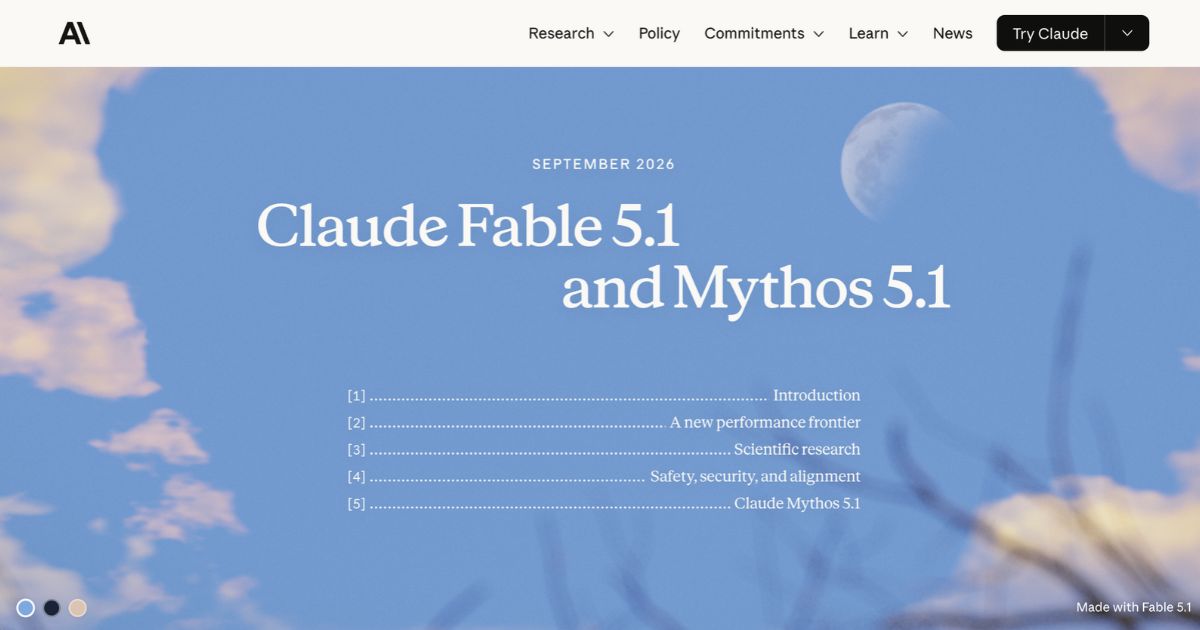
Claude Fable 5.1 (and its closely related Mythos 5.1) is Anthropic’s newest model specializing in high-stakes knowledge work and coding tasks. Designed to handle complex, long-running workflows such as multi-stage research, enterprise deliverables, and ambitious agent-led automation, it brings stronger performance for reasoning, vision, and autonomous task completion than previous models. Mythos 5.1 is available only by invitation under Anthropic’s Project Glasswing but otherwise shares the same features and specifications as Fable 5.1.
Key Features
Very large context window—1 million input tokens—allowing it to ingest extensive documents, codebases, or long-running projects and maintain context over sustained tasks. Max output is up to 128,000 tokens.
Input supports both text and images, enabling it to work with charts, diagrams, spreadsheets, legal documents, architectural plans, and other visuals embedded in files or PDFs.
“Adaptive thinking” is always on. The model uses proactive tool use, progress tracking, and error recovery in workflows without requiring constant guidance. It can plan multi-step tasks, detect its own mistakes, and serially refine outputs.
Safer interactions: content provenance is maintained and visible, cache reads have been made significantly cheaper, and enterprise-level safeguards are in place, including automatic fallback to less capable models for certain categories of high-risk requests (such as bioweapons or exploit code).
New beta features like per-message effort settings, turn-scoped system messages, and displayable progress updates between tool calls enhance control and transparency for users.
Pricing
Input tokens are priced at USD 10 per million tokens; output tokens cost USD 50 per million. Cache reads are dramatically cheaper at USD 0.25 per million tokens, approximately 75% less than before.
The same pricing applies to Claude Mythos 5.1 when access is granted.
There are discounts via the batch API, interest especially to organizations with heavy usage. Cache writes (isolated intervals like 5-minute or 1-hour windows) also carry specific costs (e.g., USD 12.50 to USD 20 per million tokens).
For users concerned about data location, Fable 5.1 supports inference restricted to US-only regions for about 10% higher cost (a 1.1× multiplier).
Who is it for?
Enterprises and teams handling deep, document-heavy workflows—legal, financial, scientific or architectural work that includes large documents, detailed charts, multiple data formats, or long chains of reasoning.
Software engineering leaders and development teams working on large codebases, requiring code reviews, performance optimizations, interdependent module work, or autonomous testing—projects that span days and need robust self-correction and vision-based validation.
Project managers and knowledge workers who assign agentic tasks—tasks where the AI actively plans, executes across tools, recovers from errors, and updates stakeholders without continuous oversight.
Decision-makers and C-suite adopting AI in regulated environments—where safety, auditability, data provenance, model fallback, and cost visibility are essential. Fable 5.1’s safeguards make it attractive in use cases with sensitive data or compliance requirements.
Final thoughts
Claude Fable 5.1 stands out among modern large language models for its capacity to sustain complex, multi-step work across formats, its advances in cost-efficiency (especially via cheaper cache reads), and its enhanced safety and control features. Its pricing is relatively high, meaning that for simpler or shorter tasks, less capable models may be more economical. But for businesses wrestling with ambitious, data-intensive, or long-duration workflows—and which need robust reasoning, vision, and agentic autonomy—Fable 5.1 represents one of the most capable options available today.
Visit the official website for more.
Keep up to date with our stories on LinkedIn, Twitter, Facebook and Instagram.